
Beer Industry Welcomes Karnataka’s AIB-Based Alcohol Tax Reform: A Landmark Shift in India’s Excise Policy
Karnataka has become the first Indian state to formally introduce an Alcohol-in-Beverage (AIB) based excise duty framework — a sweeping reform that is being widely celebrated by the beer and brewing industry as a historic turning point for alcohol taxation in the country.
The state government recently issued a Draft Notification to amend the Karnataka Excise (Excise Duties and Fees) Rules, 1968, marking the beginning of India’s transition toward a taxation model that links excise duty directly to the alcohol content present in a beverage, rather than applying a flat per-litre or category-based duty structure.
For India’s beer industry, which has long argued that low-alcohol beverages are unfairly penalised under existing excise frameworks, this reform could not have come soon enough.

→ UP Begins Preparations for Excise Policy 2027-28, Stakeholder Meetings from September 28→ Supreme Court Says Alcohol Prohibition Does Not End Alcoholism, Cites Gujarat’s Hooch Tragedies
What Is AIB-Based Taxation and Why Does It Matter?
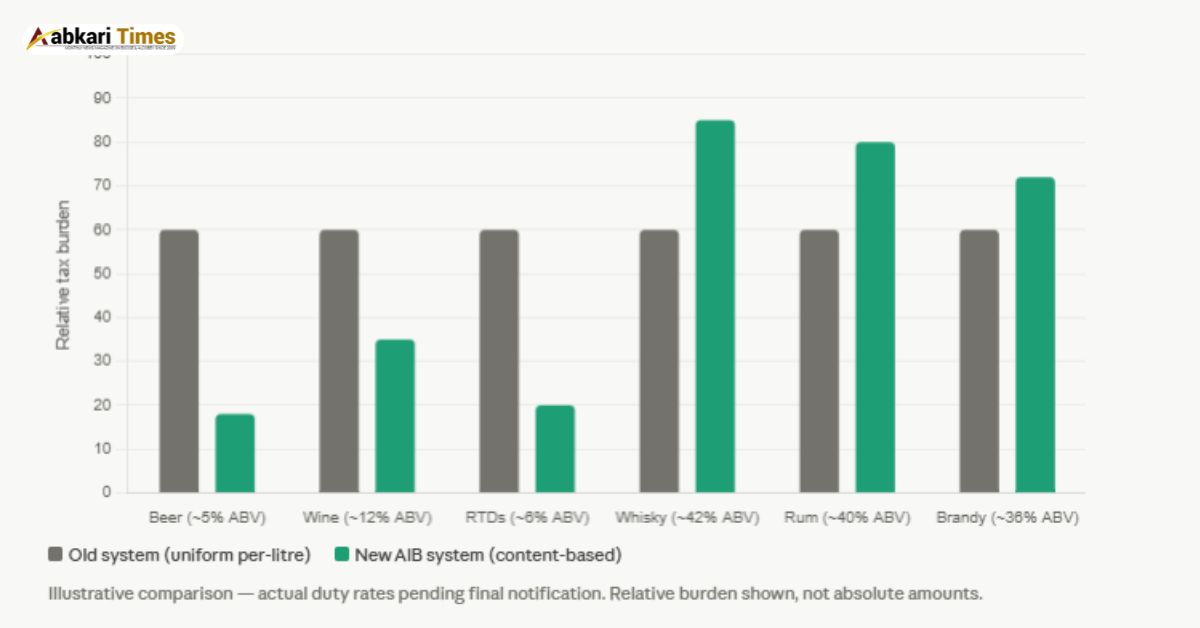
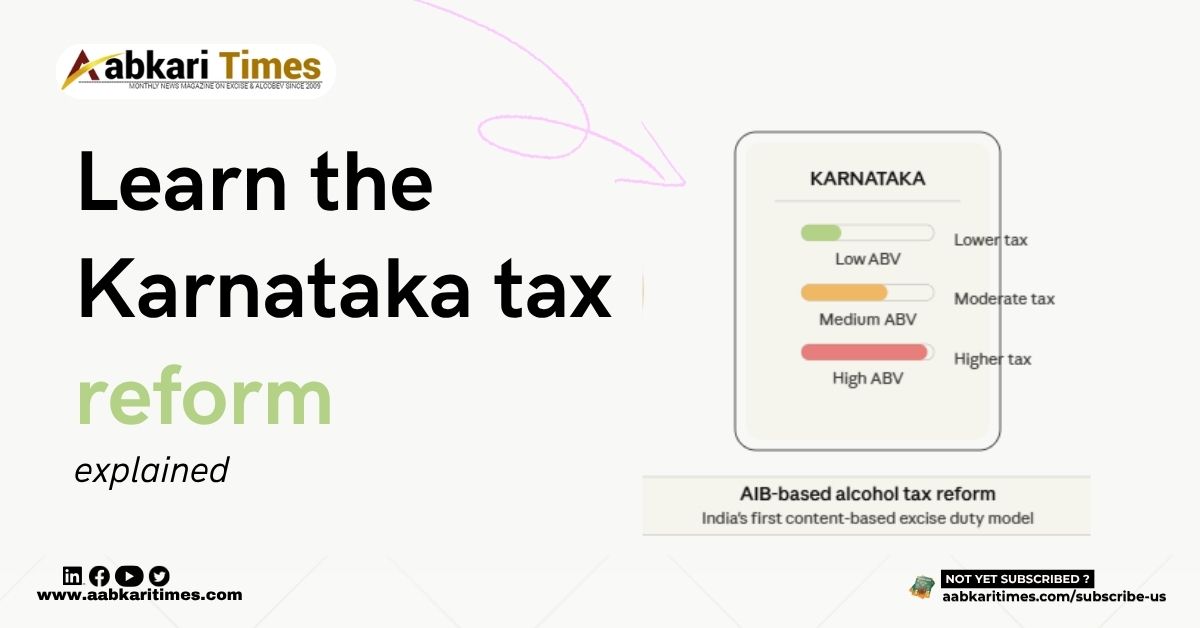
At its core, the AIB-based excise duty structure taxes alcoholic beverages according to their alcohol content — measured by Alcohol by Volume (ABV) — rather than by the total volume of liquid or by broad product categories. Under this approach, a beer with 5% ABV would attract significantly lower excise duty than a whisky or brandy with 40% or more alcohol content.
This model is widely regarded as the global gold standard for alcohol taxation. The World Health Organization (WHO) has recommended it as the most effective way to align taxation with public health objectives, since it directly targets the component of alcoholic beverages — the alcohol itself — that is responsible for potential health risks and social costs.
Countries across Europe, North America, and the Asia-Pacific region have long adopted some version of content-based alcohol taxation. Until now, however, no Indian state had explicitly structured its excise duty system around this principle, making Karnataka’s move a first-of-its-kind reform in the country.
How Karnataka’s Reform Reshapes the Landscape
The reforms were first announced by Chief Minister Siddaramaiah during the presentation of the Karnataka State Budget 2026–27 in March 2026 and are now in the formal notification stage. Here’s what the new framework entails:
Taxation linked to alcohol content: The core shift replaces the existing uniform per-litre duty with a graduated structure where beverages with lower ABV — such as beer, wine, and ready-to-drink (RTD) formats — face proportionally lower tax, while high-ABV spirits like whisky, rum, and brandy are taxed more heavily.
End of government-controlled pricing: Until this reform, the Karnataka Excise Department fixed the maximum retail price (MRP) for every alcoholic product sold in the state. Manufacturers now have the freedom to determine their own retail prices, creating a market-driven pricing environment for the first time.
Simplification of pricing slabs: The existing system of 16 pricing categories has been consolidated into just eight, reducing administrative complexity for producers, distributors, and regulators alike.
Phased implementation: The transition is designed to unfold gradually over three to four years to avoid sudden market disruptions, giving all stakeholders — from manufacturers to retailers — time to adapt.
Beer Industry’s Response: Optimism and Opportunity
The Brewers Association of India (BAI), which represents industry leaders United Breweries, ABInBev, and Carlsberg — collectively accounting for roughly 85% of India’s beer market — has been among the most vocal supporters of the reform.

BAI’s Director General, Vinod Giri, described the AIB-based taxation as a watershed moment for India’s excise policy. The association has emphasised that taxing the alcohol content rather than the water that accompanies it is not just economically sound but also aligns with global best practices in public health. BAI has expressed hope that other Indian states will follow Karnataka’s lead in explicitly linking tax structures to alcohol content.
Beyond the brewers, the International Spirits and Wines Association of India (ISWAI) and the Confederation of Indian Alcoholic Beverage Companies (CIABC) have also welcomed aspects of the reform. While the spirits industry has expressed some caution — noting that higher-ABV products could face increased tax burdens — the overall sentiment has been positive, particularly around the removal of price controls and the reduction of pricing slabs.
Nuvama, a leading equity research firm, has projected that the reform could trigger a sharp uptick in beer volumes in Karnataka by FY2027, especially given the low base after double-digit volume declines in the current fiscal year. The firm noted that the tax shift is particularly positive for beer due to its lower alcohol content relative to spirits.

Posts Express
Bira 91 Revival Plan Anicut-Led Board Offers to Buy Out Key Investors
Bira 91 maker B9 Beverages is exploring a major restructuring and recapitalisation…
The Revenue Equation: Can Karnataka Have It Both Ways?
One of the most compelling aspects of Karnataka’s reform is the state government’s argument that the AIB-based model can simultaneously maximise revenue and improve public health outcomes — goals that are often seen as conflicting.
Karnataka’s excise sector is a significant revenue engine. Collections from liquor reached approximately ₹36,492 crore by February 2026, reflecting a 12.7% year-on-year increase. The state has set an ambitious target of ₹45,000 crore in excise revenue for FY2026–27.
The logic behind the revenue optimism is straightforward: by making lower-alcohol beverages like beer and wine more competitively priced, the state expects to expand the overall consumption base and drive volume growth. At the same time, higher duties on strong spirits maintain — and could even increase — per-unit tax yield from the premium end of the market.
The BAI has pointed out that Karnataka has explicitly become the first state in India to link its revenue maximisation goal with desired public health outcomes. The association views this dual framing as a template that other states could replicate.
A Boon for Bengaluru’s Thriving Craft Beer Scene
Bengaluru, often referred to as India’s craft beer capital, stands to gain significantly from this reform. The city’s thriving microbrewery culture, its large population of young urban professionals, and its established reputation as one of India’s most vibrant nightlife hubs make it a natural beneficiary of policies that favour lower-alcohol beverages.
The new policy continues to support the craft beer segment through separate licensing provisions for microbreweries, draught beer supply permissions, and an increasing number of retail vendor beer licences. Additionally, the government is exploring alcohol tourism initiatives — including beer and whisky trails, winery tastings, and direct-to-visitor sales — as part of its broader strategy to position Karnataka as a destination for beverage tourism.
The reform also grants breweries and distilleries permission to operate around the clock, a move that could significantly boost production capacity and operational efficiency.
The Bigger Picture: Implications for India’s Fragmented Excise Landscape
India’s alcohol taxation system is among the most complex and fragmented in the world. Unlike most countries where alcohol duties are set at the national level, Indian states individually administer and collect excise revenue, resulting in widely varying tax rates, structures, and regulatory frameworks across the country.
This fragmentation creates significant challenges for alcohol companies operating across multiple states — each market requires separate pricing strategies, compliance processes, and product configurations. It also leads to cross-border arbitrage and contributes to the illicit liquor trade.
Karnataka’s adoption of AIB-based taxation could serve as a powerful proof of concept. If the state demonstrates that content-based duty structures can deliver strong revenue growth while simplifying compliance and supporting public health, it could create pressure on other major alcohol markets — including Uttar Pradesh, Maharashtra, Telangana, and Tamil Nadu — to consider similar reforms.
Industry bodies have been careful to note that while the direction is encouraging, the ultimate impact will depend on the final tax formula, which has not yet been released. The draft notification is currently in the public consultation phase, and stakeholders are expected to submit feedback before the rules are finalised.
What Consumers Can Expect
For consumers in Karnataka, the most immediate impact is likely to be felt in beer and wine pricing. Under the AIB model, these lower-alcohol categories are expected to see a relatively lower tax burden compared to spirits, which could translate into more competitive retail prices over time.
However, consumers of hard spirits — particularly those in the economy and mid-price segments — may see price increases. Some estimates suggest that popular whisky, rum, and brandy brands could become at least 20% more expensive once the new duty structure is fully implemented, though the phased rollout is designed to cushion this impact.
The shift to market-driven pricing also means that premium and imported brands could become more accessible, as manufacturers gain the flexibility to set competitive prices without waiting for government approval.
Challenges and Criticisms
Despite the broadly positive reception, the reform is not without its critics.
Some segments of the spirits industry have raised concerns that a policy explicitly designed to benefit beer could eventually erode IMFL (Indian Made Foreign Liquor) sales, where per-case revenue to the state is four to five times higher than beer. If consumer behaviour shifts significantly toward lower-alcohol beverages, the net impact on total excise revenue could be more nuanced than projections suggest.
The wine industry has also noted that while breweries and distilleries have been granted 24-hour operational permissions, wineries have not been explicitly included — a gap that some view as an oversight in an otherwise comprehensive reform package.
Additionally, the reform arrives against a backdrop of political controversy. Opposition parties have raised allegations of corruption linked to alcohol licence allocations, though the government has denied these claims.
Looking Ahead: A Template for the Nation?
Karnataka’s AIB-based tax reform represents more than just a state-level policy change. It signals a fundamental rethinking of how India approaches alcohol taxation — moving away from legacy systems rooted in colonial-era frameworks toward a modern, evidence-based model that balances fiscal objectives with public health priorities.
For the beer industry, which has long operated at a disadvantage under India’s existing excise structures, the reform validates years of advocacy. For policymakers in other states, it offers a live case study in whether content-based taxation can deliver on its dual promise of revenue growth and harm reduction.
As the draft notification moves through public consultation and toward final implementation, all eyes will be on Karnataka to see whether this landmark reform lives up to its transformative potential.
About the Author
Aabkari Times Newsdesk
Administrator
Aabkari Times Editorial Team covers India's excise policy, liquor industry news, AlcoBev sector, state excise regulations, and alcohol taxation. Published from Prayagraj since 2009, Aabkari Times is India's only dedicated Hindi monthly magazine for the excise and alcohol industry.