
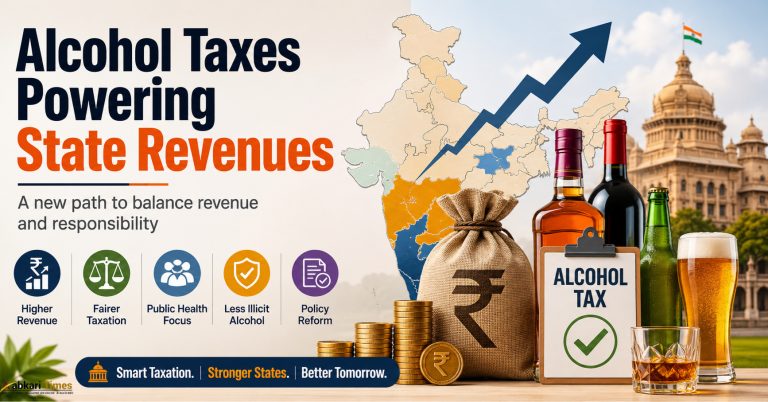
As financial pressures mount, several Indian states are increasingly depending on alcohol taxes to strengthen their finances. While many governments publicly advocate restrictions on liquor consumption, alcohol has become one of the most important sources of state revenue in the post-GST era.
A Contradictory Relationship With Alcohol
India’s Constitution encourages governments to work toward prohibition through its Directive Principles of State Policy. Reflecting this vision, many states continue to impose restrictions such as dry days, permit requirements, and partial bans on alcohol sales.
However, the reality is far more complex. States frequently grant exemptions to hotels and tourist destinations, while some regions have relaxed restrictions to attract investment and business activity. The need for revenue has often outweighed ideological commitments to prohibition.
 John Distilleries Crosses ₹10,000 Crore Revenue in FY26 as Sazerac Becomes Majority Shareholder
 Mount Everest Breweries Files DRHP for ₹300 Crore IPO to Fund Expansion and Debt Repayment
GST Changed State Finances
The introduction of the Goods and Services Tax (GST) in 2017 transformed India’s taxation system by replacing numerous state-level taxes with a unified framework.
While GST improved economic efficiency and created a national market, it also reduced states’ ability to independently raise taxes. Today, state governments have limited flexibility in generating additional revenue, with alcohol and fuel remaining among the few major sectors they can tax directly.
At the same time, rising welfare spending, subsidies, and electoral promises have placed increasing pressure on state budgets, forcing governments to search for reliable revenue streams.
Why Alcohol Taxes Matter
For many states, alcohol taxation offers a politically manageable way to boost income.
Unlike fuel taxes, which directly affect transportation costs and inflation, liquor taxes impact a smaller portion of the population. According to survey data cited in policy discussions, only around 20% of Indian men report consuming alcohol, while alcohol consumption among women remains extremely low.
As a result, governments often view alcohol duties as an efficient method to generate revenue without imposing broader economic costs.
The Challenge of Finding Balance
States face a difficult balancing act.
Excessively high taxes can push consumers toward cheaper products or illegal liquor, increasing health risks and causing loss of revenue. On the other hand, governments must avoid appearing to encourage alcohol consumption because prohibition and anti-alcohol campaigns remain politically popular in many regions.
This has led policymakers to seek a taxation framework that generates revenue while reducing social harm.
Karnataka’s New Approach
Karnataka has emerged as a potential leader in alcohol policy reform.
A state-appointed committee recently proposed a major overhaul of the excise taxation system. The report highlighted a key problem in the current structure: alcoholic beverages are often taxed based on product category rather than actual alcohol content.
For example, beer containing 5-8% alcohol may face significantly higher taxation relative to its alcohol content than spirits containing around 40% alcohol. Premium brands can also attract higher taxes despite having alcohol levels similar to lower-priced products.
To address these inconsistencies, the committee recommended a taxation system based primarily on the amount of alcohol contained in a product, regardless of whether it is sold as beer, wine, whisky, gin, or another category.
Such systems are already widely used in countries including Australia and the United Kingdom.
Potential Benefits
Experts believe the proposed reforms could deliver several advantages:
- Higher and more predictable tax revenue.
- A fairer taxation structure across beverage categories.
- Reduced market distortions.
- Better alignment between taxation and public health objectives.
- Lower incentives for consumers to switch to unsafe illicit alcohol.
Recognizing these benefits, Karnataka has already begun implementing some initial reforms.
Could Other States Follow?
India’s federal structure often encourages successful state-level policies to spread rapidly across the country.
If Karnataka’s reforms succeed in increasing revenue while maintaining political acceptance, other states facing fiscal stress may adopt similar models.
With state finances under pressure and limited alternatives available, alcohol taxation is likely to remain a central part of India’s revenue strategy for years to come.
Conclusion
The growing dependence on alcohol taxes highlights a broader challenge facing Indian states after GST. Governments must balance public health concerns, political realities, and fiscal needs.
Karnataka’s proposed alcohol-tax reform represents a significant shift toward a more evidence-based and economically rational approach. If successful, it could become a blueprint for alcohol taxation across India, helping states raise revenue while reducing unintended consequences associated with current policies. :::
About the Author