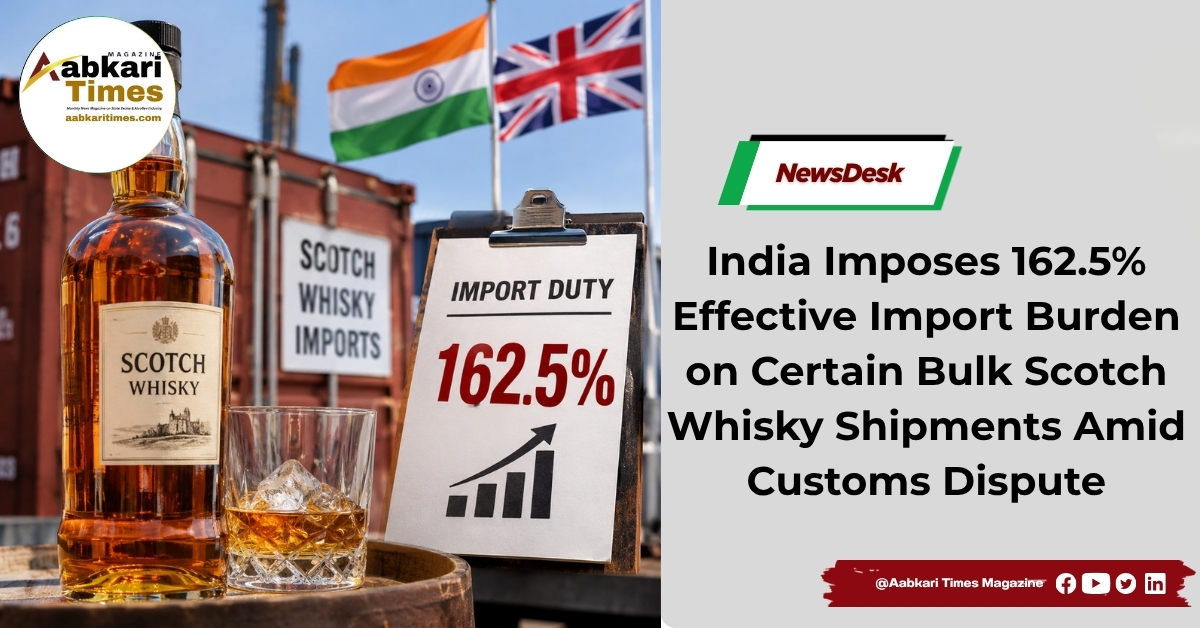


New Delhi: India and the United Kingdom are working to resolve a dispute over customs classification of bulk Scotch whisky imports following concerns raised by the UK government, with both sides seeking to ensure that the issue does not affect the implementation of the India-UK Free Trade Agreement (FTA). Indian trade and finance ministry officials are reportedly working to address the matter in the coming days while complying with domestic court decisions and the country’s commitments under the trade pact.
Agrawal said the UK government had formally flagged the issue to India, but stressed that New Delhi remained committed to implementing the agreement. He indicated that there was no reconsideration of India’s commitments and that discussions with UK authorities were focused on resolving differences in interpretation.
The India-UK trade agreement, which came into effect in July, reduced tariffs on Scotch whisky imports by half, bringing the applicable duty down to 75%. The reduction was welcomed by the British government and major global spirits companies, including Pernod Ricard and Diageo, which import bulk Scotch whisky into India for blending and production of popular whisky brands in the country’s approximately US$65 billion alcoholic beverage market.
 TASMAC Introduces Digital-Only Payments at Elite Liquor Shops in Chennai to Curb Overcharging
 Inside SMAC How India’s 7,500-Member Single Malt Whisky Community Is Building a Culture of Whisky Appreciation
However, the tariff arrangement has encountered an interpretation dispute involving the customs classification of bulk Scotch whisky concentrates. Indian investigators have reportedly questioned whether some companies are using the correct customs classifications, arguing that certain imported bulk concentrates should be treated as raw materials used in the manufacture of blended whisky rather than finished alcoholic beverages.
The disagreement initially affected shipments belonging to Pernod Ricard, Diageo and Bacardi, with thousands of litres of Scotch whisky held up in more than 80 shipping containers at Indian ports, according to earlier Reuters reporting. Agrawal subsequently confirmed that the containers had been released, easing an immediate disruption to imports.
He also indicated that trade negotiators on both sides had not been fully aware of certain Indian court rulings concerning tariff-related matters. These earlier decisions have contributed to differing interpretations of the applicable customs provisions.
The resolution of the dispute is important for the Scotch whisky industry, which views India as a major growth market. Both governments are now seeking to reconcile customs interpretations with the tariff commitments under the India-UK FTA.
About the Author