

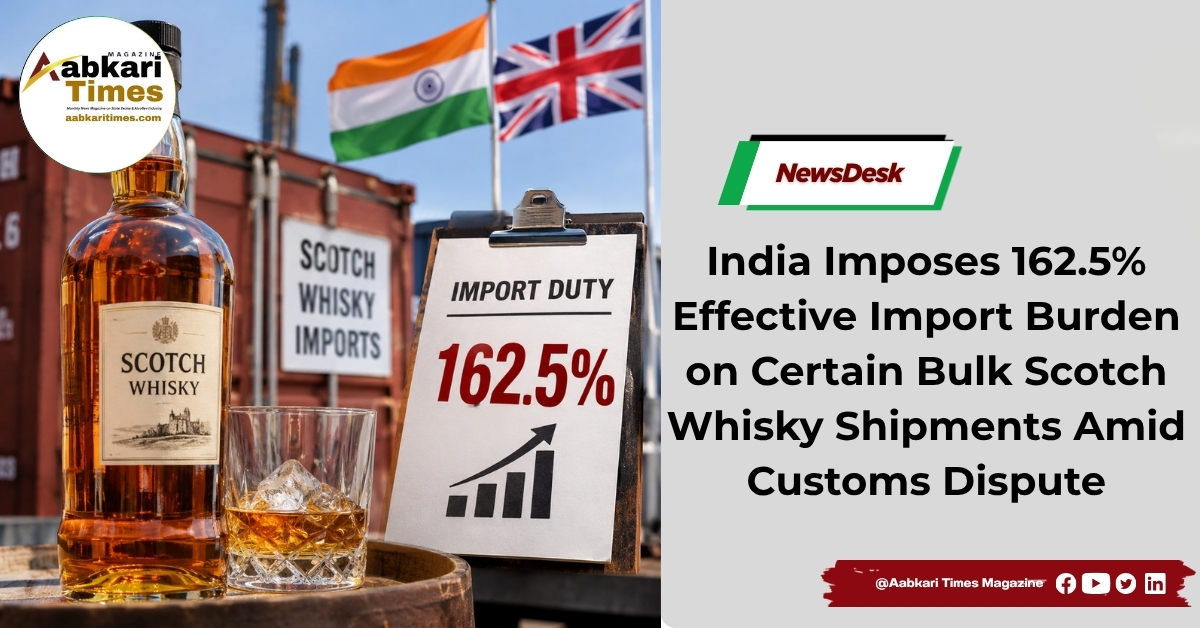
New Delhi: Certain bulk Scotch whisky imports from Scotland are facing an effective combined tariff and tax burden of 162.5% in India, according to a Reuters investigation reported by Business Today on November 18, 2026. The development has raised concerns among international exporters and Indian distillers, as the customs classification dispute could increase the cost of whisky inputs used in domestic blending operations, despite tariff reductions under the India–UK trade agreement.
The reported import burden applies to specific bulk shipments of concentrated Scotch whisky used by Indian manufacturers to produce blended whiskies. The dispute centres on how Indian customs authorities classify these concentrated whisky inputs at the border. According to the report, which cited eight sources and a government document, authorities are challenging the classification adopted for certain imports, potentially resulting in significantly higher duties and taxes.
Under the India–UK trade agreement, the tariff on qualifying Scotch whisky was reduced to 75%. However, the reported effective burden of 162.5% includes the combined impact of customs duties and other applicable taxes, calculated against the import value. This is higher than the 150% level that applied before the trade agreement, creating concerns that the revised customs treatment could offset the intended benefits of tariff reductions.
 India–UK Trade Deal Scotch Whisky Industry Faces Customs Classification Dispute Over Bulk Imports
 Pernod Ricard Considers India IPO as Market Strengthens Its Global Importance
The issue is particularly significant for Indian distillers and blending companies that depend on bulk Scotch whisky as a production input. Higher import costs could increase manufacturing expenses, put pressure on profit margins and raise working capital requirements. Companies importing concentrated whisky in large volumes may also face challenges in planning procurement, pricing and future supplies.
The report stated that some consignments are being provisionally cleared after importers make payments and provide guarantees while the classification dispute remains unresolved. Although this arrangement allows shipments to continue moving, businesses remain exposed to uncertainty over their final import costs.
The United Kingdom is also engaged in discussions concerning the issue, given the importance of Scotch whisky exports and India’s growing significance as a spirits market.
Importantly, the reported 162.5% burden does not apply to all Scotch whisky imports into India. It concerns specific bulk shipments whose customs classification is under dispute, rather than the wider market for bottled Scotch whisky. The outcome could have implications for the implementation of the India–UK trade agreement and the economics of India’s blended whisky industry.
About the Author