

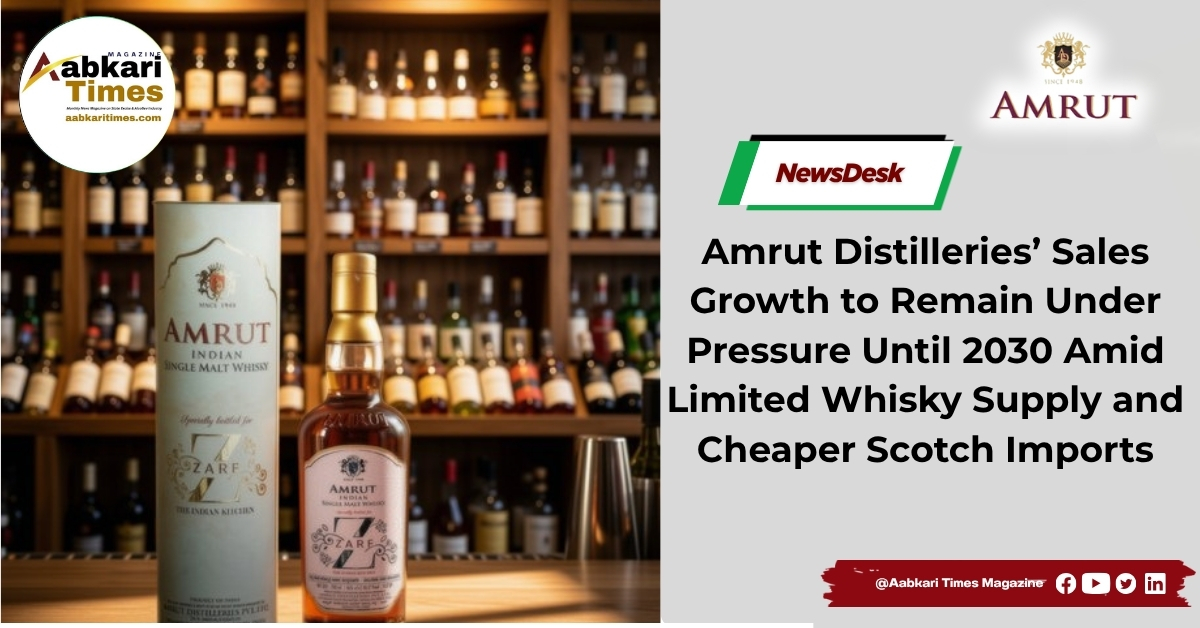
Bengaluru-based distiller plans to expand beyond single malt, explore a tequila partnership with Mexican producers and introduce a more affordable whisky as competition intensifies
Mumbai: Amrut Distilleries, one of India’s pioneering single malt whisky producers, expects its sales growth to remain constrained until 2030 as demand continues to exceed available supplies. Managing Director Rakshit Jagdale said the company’s ability to increase sales will remain limited in the coming years, while lower-priced Scotch whisky imports following the India-UK free trade agreement (FTA) are expected to intensify competition for domestic whisky brands.
“Before 2030, we’ll see sort of flat sales because that’s the quantity that we have. We cannot increase the quantity,” Jagdale said, highlighting the production limitations facing the Bengaluru-based distiller. Amrut currently holds an inventory of approximately 75,000 nine-litre cases of single malt whisky. Although the company expanded its distillation capacity to around 1.3–1.4 million litres last year, a significant increase in market supply will take time because Indian single malt whisky generally requires at least three years of maturation.
 Japan Cuts Beer Taxes, Making Regular Beer Cheaper from October 2026
 Karnataka Liquor Sales Flat in H1 FY27 as Beer Volumes Surge 41% Under New AIB Policy
To sustain growth despite these production constraints, Amrut Distilleries is diversifying its portfolio beyond single malt whisky. The company has introduced blended malt whisky to strengthen its presence in the premium spirits segment without depending entirely on a category where production increases require substantial lead time. Amrut also has a presence in rum and brandy and is exploring a potential partnership with Mexican distilleries to develop its own tequila brand. The initial plan could involve bottling the product in Mexico before the company considers shifting operations to India.
The company is also preparing to introduce a more affordable single malt whisky in North India before December 2026. The proposed product is expected to be priced approximately 15% below its Fusion brand, allowing Amrut to reach a wider consumer base amid increasing price competition in the premium whisky market.
Meanwhile, the growing availability of competitively priced Scotch whisky imports is adding pressure to Indian spirits manufacturers. Prices of some imported Scotch brands have reportedly declined by more than 15%, affecting Amrut’s sales in North India, a key market for the company. Jagdale said the company is monitoring the impact of the India-UK FTA before making any significant changes to its pricing strategy.
India’s single malt whisky market has expanded considerably in recent years, with domestic single malt sales increasing sixfold since 2020. Amrut and Paul John were among the first Indian brands to establish themselves in the category during the 2000s. The market has since attracted several new entrants, including Rampur from Radico Khaitan, Indri and Kamet from Piccadily Agro, and offerings from multinational spirits companies such as Pernod Ricard and Diageo, which have introduced Longitude 77 and Godawan, respectively.
With demand for Indian single malts continuing to grow, Amrut’s near-term strategy will focus on portfolio diversification, more accessible premium offerings and potential international partnerships. However, the combination of long whisky maturation cycles and stronger competition from imported Scotch is likely to shape the company’s sales performance through the end of the decade.
About the Author