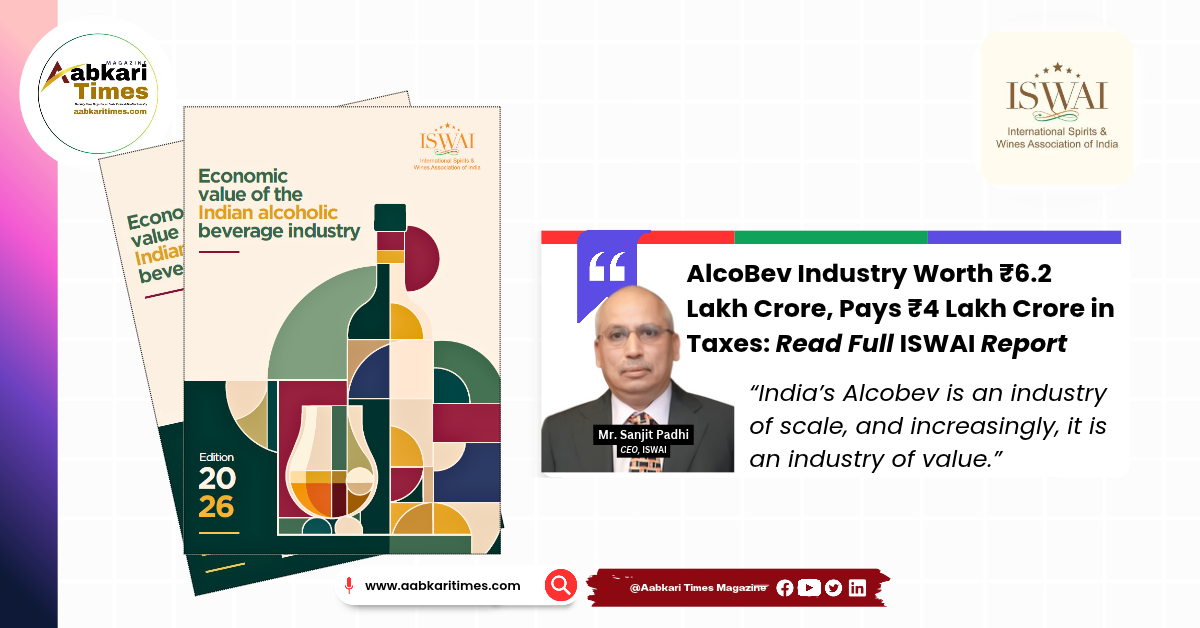


India’s alcoholic beverage (AlcoBev) industry contributed approximately ₹4 trillion in central and state taxes during the financial year 2024-25 (FY25), accounting for a significant share of government revenues, according to the International Spirits and Wines Association of India (ISWAI). The findings, published in the report titled Economic Value of the Indian Alcoholic Beverage Industry 2026, highlight the sector’s growing economic importance, with alcohol contributing around 6.6% of India’s total tax collections, 11.3% of indirect taxes and 19.1% of states’ own tax revenue.
Telangana recorded the highest dependence on alcohol-related taxes among Indian states, with the sector accounting for 32% of its own tax revenue in FY25. Tamil Nadu ranked second at 27%, followed by Uttar Pradesh at 25%. Kerala, Himachal Pradesh, Arunachal Pradesh and Chhattisgarh each recorded a 23% share, while Andhra Pradesh and Uttarakhand reported 21% each. Odisha, Madhya Pradesh, Karnataka and Punjab recorded 20% apiece, followed by Rajasthan at 19% and Haryana at 18%.

The industry’s tax contribution has increased substantially in recent years, rising from approximately ₹2.4 trillion in FY21 to around ₹4 trillion in FY25, according to figures cited in ISWAI’s reports. Sanjit Padhi, Chief Executive Officer of ISWAI, expressed concern over the sector’s growing importance as a source of government revenue, noting that higher dependence can also reflect a heavier tax burden on the industry. He said the association considers a share of 20–25% of states’ own tax revenue to be an ideal range.
The report estimates that India’s alcoholic beverage market was valued at ₹6.2 lakh crore in calendar year 2025, equivalent to approximately 1.8% of the country’s nominal GDP for FY26. This represents substantial growth from ₹3.9 lakh crore in CY2021, when the market accounted for around 1.6% of nominal GDP for FY22, as highlighted in ISWAI’s 2023 report.
 AlcoBev Industry Worth ₹6.2 Lakh Crore, Contributes ₹4 Lakh Crore in Taxes: Read Full ISWAI Report
 India’s Alcobev Market Sees Growing Interest in Low-Alcohol and Fruit-Flavoured Drinks
Padhi explained that states rely heavily on four major sources of own tax revenue: petroleum, stamp duty from real estate transactions, mining royalties and alcohol. Differences in these revenue sources help explain variations in states’ dependence on alcohol taxation. Telangana, which has relatively limited mining revenue, recorded a 32% share, while Maharashtra, which generates substantial revenue from petroleum, had a comparatively lower share of 12%.
Beyond taxation, the AlcoBev industry supports a broad agricultural and manufacturing ecosystem. According to the report, approximately 2.42–2.55 million farms and 12.14–12.81 million farmers are involved in producing agricultural inputs such as grains, sugarcane, molasses, barley and grapes used by the industry. The report also estimates that around 14–19% of organised food and beverage revenue is linked to alcohol, while 0.91–1.1 million people are employed in alcohol-licensed food and beverage outlets.
The sector also plays a significant role in India’s packaging industry. The report estimates that alcoholic beverages account for approximately 70% of the country’s container glass demand, valued at around ₹10,000 crore. ISWAI said the report aims to demonstrate the industry’s contribution to government revenues, agricultural livelihoods, employment, hospitality and manufacturing, while encouraging a broader understanding of its economic significance among policymakers and other stakeholders
About the Author