
New Delhi: Varun Beverages is making a major push into India’s alcoholic beverages market, with its newly incorporated subsidiary Kiva Spirits and Company Ltd reportedly in advanced discussions to acquire Alcobrew Distilleries India Ltd. According to people familiar with the matter, the proposed transaction could value Alcobrew at an enterprise value of around ₹2,000 crore to ₹2,500 crore. However, the deal structure and final terms have not yet been finalised.
Kiva Spirits was incorporated at the end of August as a wholly owned subsidiary of Varun Beverages, marking the company’s strategic entry into the alcoholic beverage segment. Varun Beverages had earlier announced that the new entity would focus on ready-to-drink (RTD) alcoholic beverages and allied products. The company has also appointed former Diageo executive Prathmesh Mishra as the CEO and Managing Director of Kiva Spirits.
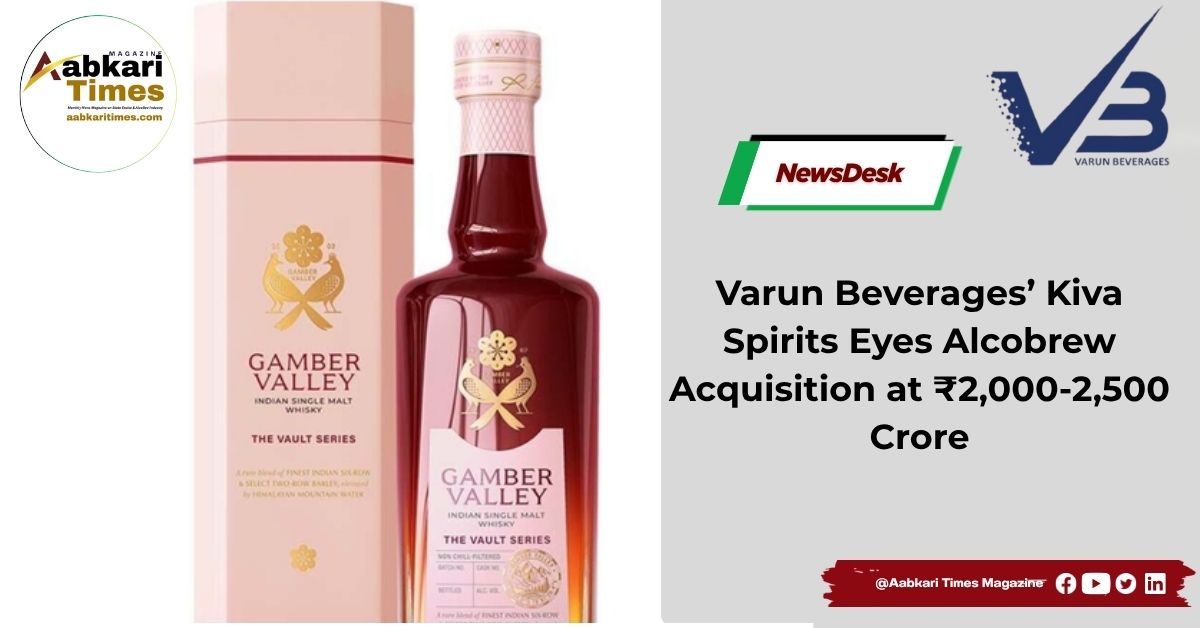
The reported acquisition of Alcobrew could give Kiva immediate access to an established portfolio of liquor brands, manufacturing infrastructure and distribution capabilities instead of building the business entirely from scratch. Alcobrew has a diversified spirits portfolio covering whisky, vodka, gin, brandy and rum. Its brands include Gamber Valley single malt, White & Blue, Golfer’s Shot, Golfer’s Shot 18 Hole, White Hills and Alcobrew Single Oak, along with One More vodka, Victorio brandy and Lion Daddy and Bhrum rum. The company also holds the India licence for Old Smuggler Blended Scotch whisky and Old Smuggler rum, owned by Italy’s Gruppo Campari.
 John Distilleries Crosses ₹10,000 Crore Revenue in FY26 as Sazerac Becomes Majority Shareholder
 Mount Everest Breweries Files DRHP for ₹300 Crore IPO to Fund Expansion and Debt Repayment
Alcobrew’s existing scale could make it a strategic fit for Kiva as Varun Beverages seeks to establish itself in a market with complex state-wise regulations, established distribution networks and strong brand competition. Alcobrew began operations in 2002 and currently has a presence across around 15 states and Union Territories. Its manufacturing footprint includes a distillation and bottling facility in Gamber Valley in Himachal Pradesh, established in 2022, as well as operations in Dera Bassi, Punjab. The company also has an export network spanning around 20 countries across Africa, Asia and West Asia.
Financially, Alcobrew reported revenue from operations of about ₹1,615 crore in FY2025, compared with ₹1,640 crore in FY2024, while its profit after tax increased to ₹69.45 crore from ₹62.55 crore. Its FY2025 EBITDA stood at approximately ₹119.7 crore. At the reported enterprise value of ₹2,000-2,500 crore, the proposed valuation would represent roughly 16.7-20.9 times FY2025 EBITDA, indicating a significant premium for the company’s brands, manufacturing assets, licences and distribution network.

The potential transaction comes at an important juncture for Alcobrew, which has been preparing for an initial public offering. Its draft IPO documents proposed a fresh issue of up to ₹258.25 crore and an offer for sale of up to 18 million shares by promoter Romesh Pandeita. The IPO draft prospectus was cleared by the market regulator in January, although it remains unclear whether a potential acquisition by Kiva would affect the company’s IPO plans.
Neither company has confirmed that an acquisition agreement has been signed. Alcobrew, responding to queries, said it does not comment on media speculation and would make appropriate disclosures if any development requires regulatory or statutory disclosure. Kiva had not responded to queries at the time of publication of the report. Therefore, the proposed ₹2,000-2,500 crore transaction should currently be viewed as advanced acquisition discussions rather than a completed deal.
For Varun Beverages, the reported move represents a potentially significant expansion beyond its traditional non-alcoholic beverage business. Acquiring an established spirits company could provide Kiva with brands, production facilities, licences, market access and an existing distribution network, allowing the new business to scale faster than an organic market entry. The development also highlights the growing strategic interest in India’s alcoholic beverage sector, particularly as companies look to capture opportunities across premium spirits and the rapidly developing RTD segment.
About the Author