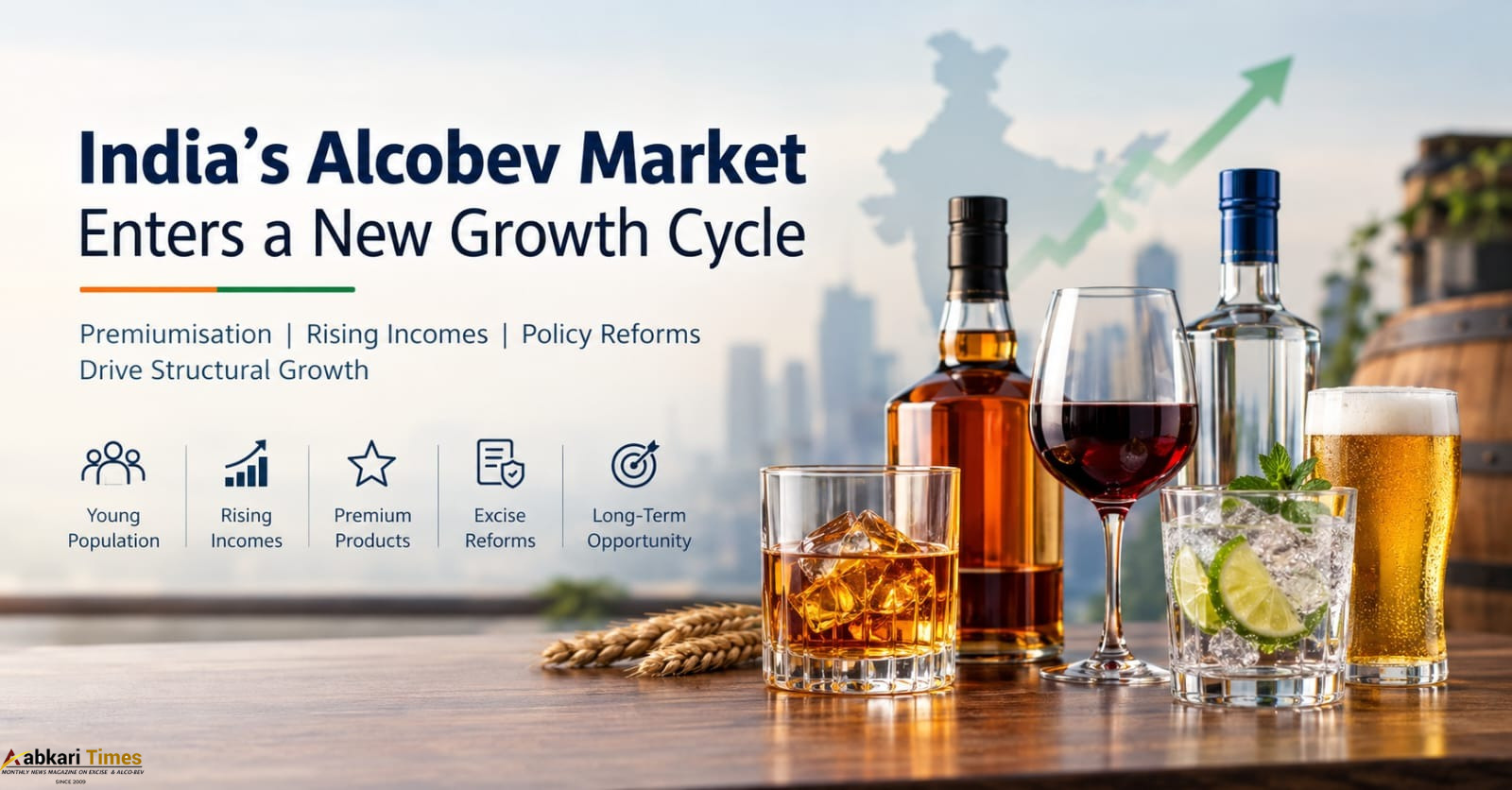
New Delhi: India’s alcoholic beverages industry could be entering a sustained phase of structural growth, supported by favourable demographics, rising disposable incomes, rapid premiumisation and a gradual shift in state-level excise policies, according to a thematic report by HSIE Research.
The report, dated September 7, 2026, describes India’s alcobev market as being at a structural turning point. Reforms in major states including Uttar Pradesh, Karnataka and Andhra Pradesh are improving the operating environment for organised alcohol companies, while early signs of policy change in Tamil Nadu could provide an additional boost to the sector.
Unlike several mature global alcohol markets that are facing volume challenges because of ageing populations and changing consumption patterns, India is expected to remain a high-growth market. HSIE estimates that the country could add nearly 100 million legal drinking-age consumers over the next five years. With a median age of around 28 years, increasing affluence and a growing aspirational middle class, Indian consumers are also becoming more willing to experiment with premium products and new beverage formats.
 Kerala Government Plans Strict Action Against Bars Serving Alcohol to People Below 23
 Odisha Bans New Liquor Shops for Three Years, CM Mohan Charan Majhi Announces Zero-Tolerance Policy on Drugs
Premiumisation Set to Remain a Major Growth Driver
India is already the world’s largest whisky market by volume and has emerged as a rapidly expanding market for categories such as vodka, gin and agave-based spirits. HSIE estimates that spirits penetration in India is currently around 40%, indicating significant room for further market development. Per-capita alcohol consumption, estimated at approximately 2.6 litres, also remains relatively low compared with several mature markets.
Premium-and-above products are expected to capture a growing share of industry value as consumers increasingly move towards higher-quality and experience-led products. Indian single malts, craft gins, flavoured vodkas and premium rums are gaining visibility, while domestic brands are increasingly competing with international labels through product quality, packaging, brand positioning and storytelling.
The growth opportunity is not limited to conventional spirits. Ready-to-drink beverages, flavoured products and cocktail-oriented formats are also benefiting from changing consumer preferences, particularly among younger legal-age consumers. HSIE expects emerging markets to account for an increasing proportion of global beverage alcohol growth and projects that India could overtake the US in 2032 to become the world’s second-largest beverage alcohol market after China.
Excise Reforms Could Reshape India’s Alcohol Market
One of the most important aspects of the HSIE outlook is the changing approach to alcohol regulation across Indian states. Because alcohol is a state subject, taxation, licensing, distribution and retail structures vary significantly across the country. However, several states are now moving towards greater transparency, pricing rationalisation and better supply-chain monitoring. Uttar Pradesh is among the most prominent examples.
Over the past three years, the state has implemented a series of measures aimed at improving retail efficiency, compliance, consumer access and excise revenue. These include composite liquor outlets offering beer and IMFL from a common location, more transparent licensing mechanisms, lower wholesale licence fees and reduced label-registration charges.
Packaging changes have also been introduced, including tetra packs for country liquor and smaller pack sizes for IMFL. Another significant change has been the cash-and-carry model, under which duty-payment responsibilities are shifted through the supply chain and transactions are routed through a centralised portal. HSIE estimates that Uttar Pradesh could eventually generate around Rs 600 billion in alcohol revenue, potentially making its evolving policy framework a reference point for other states.
Karnataka’s Policy Changes May Support Premiumisation
Karnataka has also undertaken significant changes to its alcobev policy framework through the 2026–27 Budget. From April 2026, the state introduced AIB-based taxation, moved towards deregulated government-administered pricing, rationalised pricing slabs and permitted 24-hour operations and dispatches for distilleries and breweries. The state has also placed greater emphasis on alcobev tourism.
HSIE views these measures as a positive shift after several years of policy pressure on the industry. An important potential consequence is the narrowing price differential between popular and prestige-and-above products. According to the report, the gap has declined from approximately Rs 95 to Rs 45, which could make premium products more accessible and encourage consumers to trade up.
Historical reductions in pricing slabs have similarly supported premiumisation. Radico Khaitan’s Deluxe-and-above portfolio, for instance, has recorded strong growth in Karnataka.
Andhra Pradesh Reopens the Market to National Brands
Andhra Pradesh is another state where regulatory changes are influencing the competitive landscape. Between 2019 and 2024, the state introduced restrictions on alcohol movement, brought liquor retail under greater government control, raised prices and duties and reduced retail availability. These measures had a significant impact on market volumes.
The policy direction has since changed under the new government. National and international brands have been allowed to return to the market, private operators have regained a role in liquor retail and tax and pricing structures have been simplified. According to HSIE, Andhra Pradesh recorded Rs 288.42 billion in excise revenue in FY25, representing approximately 15% year-on-year growth.
Companies Need Broader Portfolios to Capture the Opportunity
HSIE expects India’s alcohol consumer base to become increasingly segmented across three broad groups: mass-market aspirers, the emerging middle class and affluent consumers seeking premium experiences and greater self-expression.
This fragmentation could make portfolio breadth increasingly important for alcobev companies. Businesses with exposure across whisky, brandy, rum, vodka, gin, tequila and RTDs may be better positioned to capture changing consumer preferences across price segments. At the same time, traditional advantages such as distribution scale and regulatory expertise may become less decisive as the market becomes more organised.
HSIE believes future competitive strength will increasingly depend on premium brand portfolios, presence across price points, exposure to high-growth categories, regulatory alignment and execution capabilities.
Radico Khaitan, United Spirits and Tilaknagar Rated BUY
Against this backdrop, HSIE Research has adopted a positive stance on several companies in the Indian alcobev sector. The brokerage has initiated coverage with BUY ratings on Radico Khaitan, United Spirits and Tilaknagar Industries. Allied Blenders has received an ADD rating, while United Breweries has been rated REDUCE.
HSIE’s target prices are:
- Radico Khaitan: Rs 5,300
- United Spirits: Rs 1,750
- Tilaknagar Industries: Rs 700
- Allied Blenders: Rs 685
- United Breweries: Rs 1,325
The brokerage expects profitability and return metrics across much of its coverage universe to improve as premiumisation accelerates. Radico Khaitan is expected to benefit from stronger cash generation, while Tilaknagar Industries could face some pressure on returns because of leverage associated with its Imperial Blue acquisition.
India’s Alcobev Market Enters a New Growth Cycle
The HSIE thesis extends beyond individual companies and points towards a broader transformation in India’s alcoholic beverages industry. Over the coming decade, premiumisation, demographic expansion, evolving consumer preferences and state-level regulatory reforms could collectively reshape the competitive landscape.
For manufacturers, the opportunity will increasingly depend on building premium brands, expanding category exposure and adapting to different consumer segments. For states, more transparent policies and efficient supply chains could create an opportunity to balance market development with excise revenue objectives. India’s relatively young population, expanding middle class and still-low alcohol penetration provide the sector with substantial long-term headroom.
The next phase of India’s alcobev growth, therefore, may be less about simply selling higher volumes and more about selling better products, reaching new consumer segments and creating greater value across the beverage alcohol ecosystem.
About the Author