
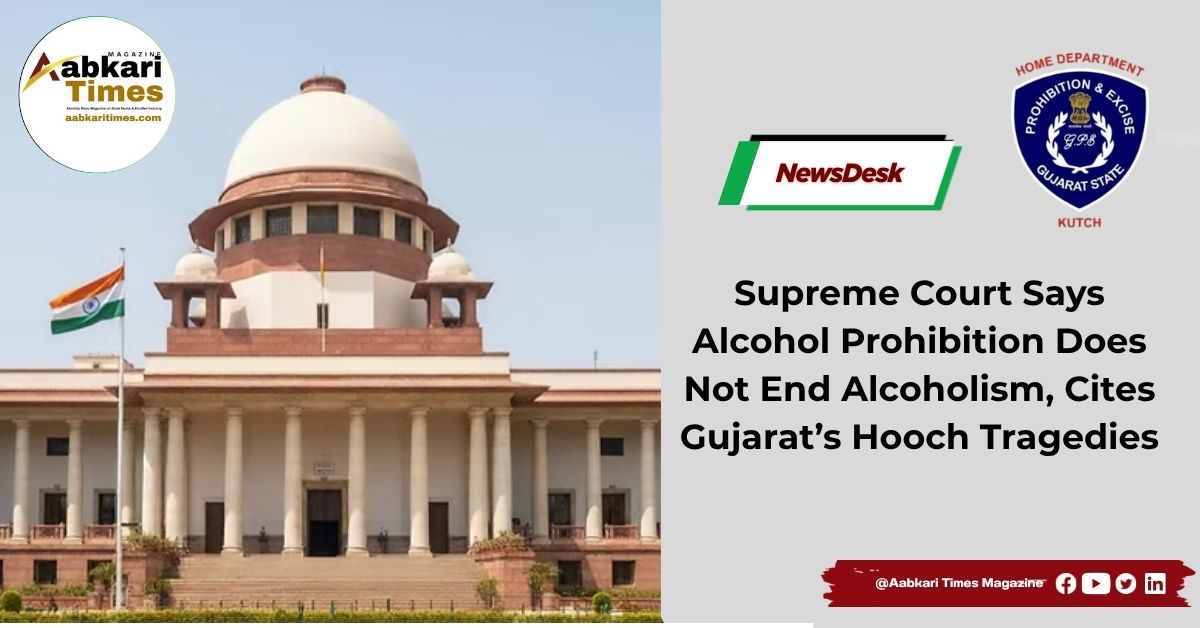
New Delhi: The Supreme Court has observed that a complete ban on alcohol does not necessarily eliminate alcoholism or prevent illicit liquor tragedies, noting Gujarat’s experience with prohibition and repeated deaths linked to spurious liquor. In a judgment delivered on September 18, 2026, a Division Bench headed by Justice J.B. Pardiwala said that a total prohibition policy can push the liquor trade underground and increase the circulation of unregulated and potentially lethal alcoholic brews.
The court noted that Gujarat, which has maintained a strict prohibition policy since its formation in 1960, has witnessed at least 10 major mass hooch tragedies, resulting in the deaths of more than 600 people. Referring to recent incidents in Bhavnagar, Gujarat, and Sagar, Madhya Pradesh, where around 13 and 15 people respectively died after consuming illicit liquor, the Supreme Court said such incidents highlighted the need for stronger measures to prevent the illegal manufacture and distribution of liquor.

The judgment identified five major concerns associated with prohibition: loss of tax revenue, expenditure on enforcement, corruption involving police and excise officials, illegal distillation and the resulting growth of related criminal and drug activities. The court observed that forced temperance alone cannot address the underlying causes of alcoholism and illicit liquor consumption.
The Supreme Court was hearing a challenge to Rules 18A and 18B of the Maharashtra Poisons Rules, which regulate the purchase of methanol and require bitterant and colourant to be added to methanol before it is sold to non-drug manufacturers. The regulations were introduced following the 1991 Mumbai spurious liquor tragedy, in which 93 of around 250 people who consumed illicit liquor purchased from Chhaya Bar died after consuming methanol-contaminated liquor.
 Odisha Collects ₹24,455 Crore in Excise Duty Over Five Years, CAG Report Reveals
 Nasha Mukt Yuva for Viksit Bharat UP Prohibition Department Holds Youth Awareness Seminar at AKTU Lucknow
The court held the challenged rules unconstitutional and arbitrary, observing that they placed a significant financial burden on industries without adequately addressing the core causes of hooch tragedies, including methanol pilferage, diversion and institutional corruption.

As part of its directions, the Supreme Court called for measures to disrupt both the supply and demand chains of illicit liquor and recommended increased vigilance along inter-State borders to curb illegal transportation. It also highlighted the misuse of open municipal school premises as storage locations for illicit liquor and called for greater monitoring of industrial units involved in manufacturing chemical solvents that could potentially be diverted for illegal liquor production.
The court further directed attention to the safe transportation of methanol, recommending that it be carried in dedicated tankers or containers to minimise the risk of pilferage, substitution and diversion. The observations underline the importance of stronger enforcement, supply-chain monitoring and controls over hazardous chemicals in preventing illicit liquor and methanol-related tragedies
About the Author