
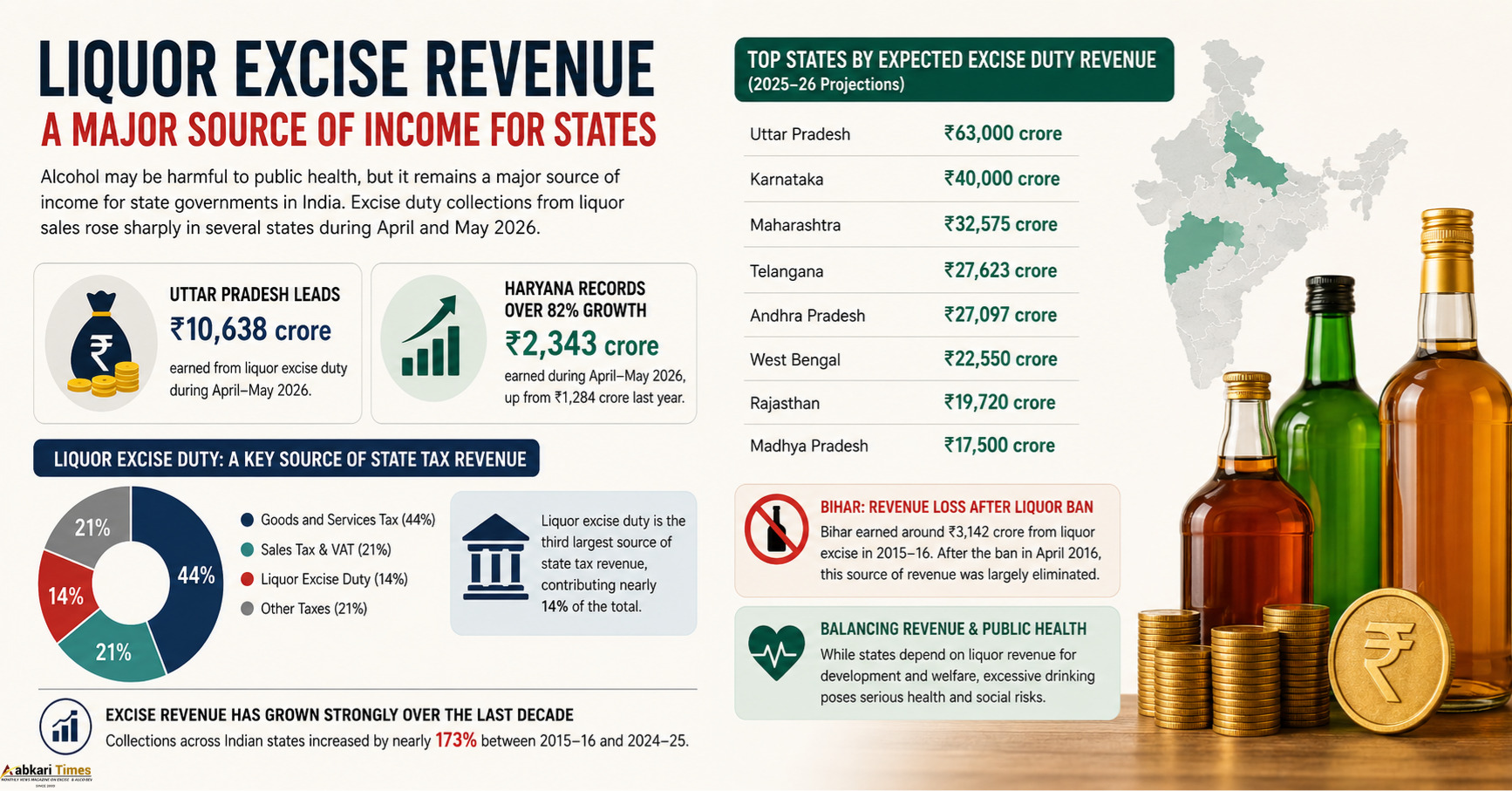
New Delhi: Alcohol may be harmful to public health, but it remains a major source of income for state governments in India. Revenue collected through liquor excise duty continues to contribute significantly to state tax collections, with several states reporting strong growth in the first two months of the 2026–27 financial year.
According to reports based on data from the Comptroller and Auditor General of India (CAG), excise duty collections from alcohol sales rose sharply in several states during April and May 2026. Uttar Pradesh recorded the highest liquor excise revenue, while Haryana witnessed one of the fastest growth rates.
Uttar Pradesh Leads in Liquor Excise Revenue
Uttar Pradesh earned more than ₹10,638 crore from liquor excise duty during April and May 2026. This translates to an average daily revenue of nearly ₹177 crore from alcohol-related excise collections.
→ Supreme Court Says Alcohol Prohibition Does Not End Alcoholism, Cites Gujarat’s Hooch Tragedies→ Meghalaya Raises Excise Duty on Liquor, Targets ₹150 Crore Additional Revenue
During the same period in the previous financial year, Uttar Pradesh collected around ₹9,770 crore. The latest figures indicate an increase of more than 9 percent in the state’s liquor excise revenue.
The strong collection highlights Uttar Pradesh’s position as India’s largest market for alcohol-related excise duty revenue.
Haryana Records Over 82 Percent Growth
Haryana reported a major rise in liquor excise collections during the first two months of 2026–27. The state earned more than ₹2,343 crore between April and May, compared with approximately ₹1,284 crore during the corresponding period last year.
This represents an increase of more than 82 percent, making Haryana one of the states with the sharpest growth in alcohol excise duty revenue.
Liquor Excise Duty Is a Major Source of State Tax Revenue
Excise duty collected from liquor sales is among the most important sources of tax income for Indian states. According to CAG data for 2024–25, Goods and Services Tax accounted for around 44 percent of state tax revenue, followed by sales tax and VAT at about 21 percent.
Liquor excise duty ranked third, contributing nearly 14 percent of total state tax revenue.
This makes alcohol taxation an important financial pillar for many state governments, especially because alcoholic beverages are not included under the GST framework and remain under the taxation authority of individual states.
Top States by Expected Excise Duty Revenue
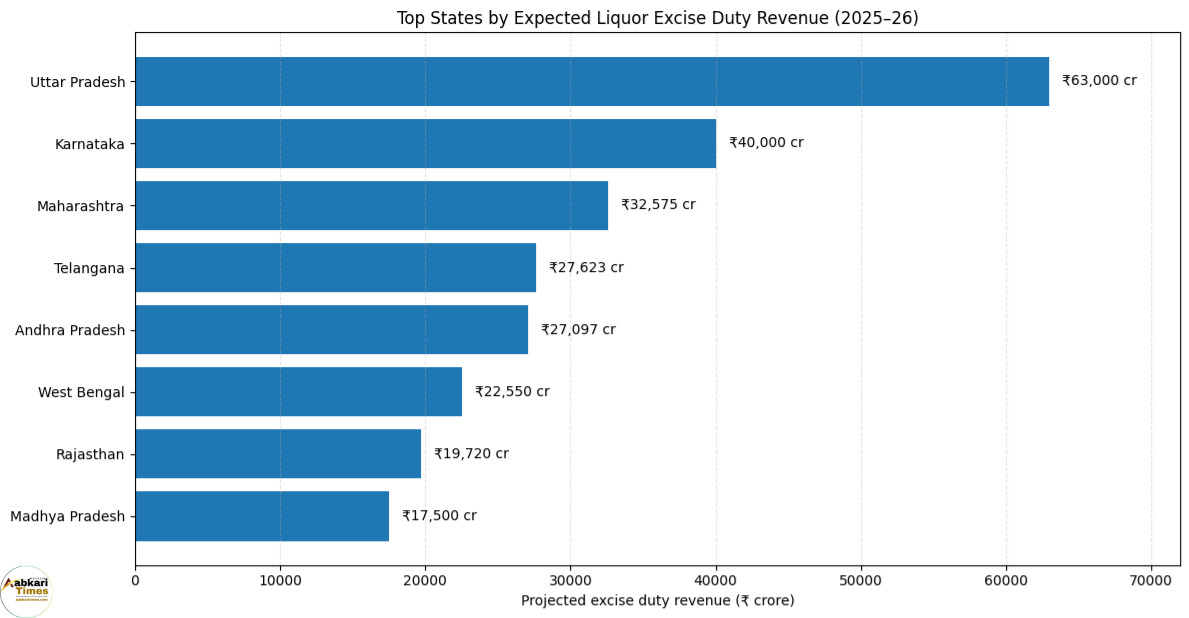
The Reserve Bank of India had projected that Uttar Pradesh could earn around ₹63,000 crore in excise duty revenue during 2025–26. Other major states expected to generate substantial income from liquor excise duty include Karnataka, Maharashtra, Andhra Pradesh, Telangana, West Bengal, Rajasthan and Madhya Pradesh.
Karnataka was expected to collect around ₹40,000 crore, followed by Maharashtra at ₹32,575 crore. Telangana’s projected excise revenue stood at about ₹27,623 crore, while Andhra Pradesh was estimated to earn ₹27,097 crore.
West Bengal was expected to generate around ₹22,550 crore, Rajasthan ₹19,720 crore and Madhya Pradesh approximately ₹17,500 crore.
Excise Revenue Has Grown Strongly Over the Last Decade
CAG reports show that excise duty collections across Indian states increased by nearly 173 percent between 2015–16 and 2024–25. The growth reflects rising alcohol consumption, expanded retail networks, higher taxation and the increasing importance of liquor revenue in state budgets.
For many states, liquor excise duty helps fund welfare programmes, infrastructure development, public services and other government expenditure.
Bihar Faces Revenue Loss After Liquor Ban
Bihar is a notable exception because the state implemented complete prohibition in April 2016. Before the ban, Bihar earned around ₹3,142 crore from liquor excise duty in 2015–16.
After prohibition, this source of revenue was largely eliminated, affecting the state’s excise earnings. The Bihar example continues to be cited in discussions about the financial impact of alcohol prohibition policies.
Alcohol Revenue and Public Health Debate
While liquor excise duty provides major financial support to state governments, alcohol consumption remains a serious public health concern. Excessive drinking is linked to road accidents, domestic violence, liver disease, mental health issues and other social and economic problems.
The growing dependence of states on liquor revenue has renewed debate over whether governments should balance revenue generation with stronger public health policies, awareness campaigns and responsible drinking measures.
About the Author