
India’s whisky consumers are becoming more informed, premium-focused and curious about craftsmanship, flavour and authenticity
India’s relationship with whisky is undergoing a major transformation. For decades, whisky was largely consumed as a social beverage where brand familiarity often mattered more than production methods or flavour complexity. Today, however, a new generation of Indian consumers is changing that perception.
Modern whisky drinkers are increasingly interested in understanding where their whisky comes from, how it is produced, what ingredients are used and how ageing, climate and cask selection influence flavour. As awareness grows, terms such as single malt, pure malt, blended whisky, maturation, cask ageing and tasting notes are rapidly entering mainstream conversations.
This shift is helping drive the rapid expansion of India’s premium and luxury whisky market. According to industry estimates by Custom Market Insights, the Indian whisky market, valued at approximately US$3.8 billion in FY2024, is projected to reach nearly US$6.8 billion by FY2033, growing at a CAGR of 6.3%.
 Scotch Whisky Association Appeals Against England’s New Single Malt Whisky Rules
 Top 10 Premium Whisky Brands in India Above ₹5,000 for the Festive Season
Indian distillers are actively capitalising on this momentum by producing world-class single malts that increasingly compete with established imported Scotch whiskies. Consumers are upgrading from standard spirits to premium expressions and are becoming more selective about quality, authenticity and flavour profiles.
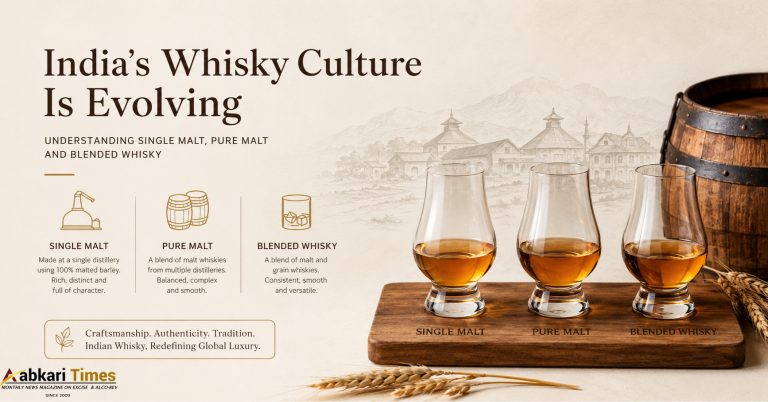
To appreciate this evolving whisky culture, it is important to understand the key differences between single malt, pure malt and blended whisky.
What Is Single Malt Whisky?
One of the most common misconceptions among whisky drinkers is that the word “single” refers to whisky coming from a single barrel. In reality, single malt whisky means the whisky is produced at a single distillery using only malted barley.
Single malt whisky is made from 100% malted barley and distilled in traditional copper pot stills. The spirit is then matured in oak casks, typically for a minimum of three years. No neutral spirits or artificial flavouring agents are added, apart from permitted caramel colouring in some cases.
The copper pot stills play a crucial role in shaping the whisky’s character, helping create rich and layered flavour profiles. During maturation, the whisky interacts with the oak casks, absorbing colour, aroma and complexity over time.
In India, climatic conditions significantly accelerate this process. The country’s warm temperatures and sharp day-night variations increase interaction between the spirit and wood, often resulting in bold tropical fruit notes, spice-driven aromas and a fuller mouthfeel compared to whiskies matured in colder climates.
Indian single malts are increasingly gaining international recognition for their unique character, craftsmanship and ability to express local terroir.
Understanding Pure Malt Whisky
Pure malt whisky, sometimes referred to internationally as blended malt whisky, is also made entirely from malted barley. However, unlike single malt whisky, it is created by blending malt whiskies sourced from two or more distilleries.
Like single malts, pure malts are distilled in copper pot stills and matured in oak casks. The difference lies in the blending process, which allows distillers to combine the distinct characteristics of multiple malt whiskies to achieve a balanced and consistent flavour profile.
This category offers whisky makers greater flexibility in crafting complexity while still preserving the richness and depth associated with malt-based spirits.
Pure malt whiskies are often appreciated by consumers seeking layered flavours with smooth integration between different regional or distillery styles.
What Is Blended Whisky?
Blended whisky represents a completely different philosophy in whisky making. Rather than highlighting the unique identity of a single distillery, blending focuses on achieving consistency, smoothness and broad consumer appeal.
Blended whiskies combine malt whisky with grain whisky, which is typically distilled using grains such as corn, wheat or rye in continuous column stills. Master blenders carefully combine various whiskies to create a flavour profile that remains stable year after year.
This blending process requires tremendous expertise. The goal is to ensure balance, approachability and versatility while maintaining a smooth drinking experience.
Blended whiskies are widely popular because they are easy to drink, suitable for cocktails and ideal for casual social occasions. Their accessibility has made them the backbone of whisky consumption across many global markets.
The Key Difference Between Single Malt and Blended Whisky
The biggest difference between single malts and blended whiskies lies in individuality versus consistency.
Single malts are celebrated for their distinctive character. Every distillery imparts its own personality through factors such as water source, barley quality, still design, fermentation process and cask management. Whisky enthusiasts often seek single malts for their unique and bold flavour identities.
Blended whiskies, on the other hand, prioritise harmony and balance. By combining multiple whiskies, master blenders can smooth out sharper characteristics and create a more consistent taste profile that appeals to a wider audience.
Neither category is inherently superior. The choice ultimately depends on personal preference, occasion and drinking style.
Indian Whisky Is Redefining Global Luxury
India is no longer viewed merely as a large consumer market for international spirits. The country is now emerging as a respected producer of premium malt whiskies that are winning accolades at global competitions and attracting international recognition.
This transformation has been driven by innovation, craftsmanship, favourable climatic conditions and a strong commitment to quality.
Indian whisky producers are combining traditional whisky-making methods with local expertise to create distinctive expressions that meet international standards. From barley selection and water sourcing to distillation and maturation, every stage reflects growing sophistication within the domestic industry.
Industry bodies and representative organisations are also playing an important role by promoting best practices, supporting quality standards and strengthening the global reputation of Indian-made spirits.
Their objective extends beyond business growth. They aim to position Indian malt whisky as a symbol of authenticity, craftsmanship and luxury on the global stage.
Whisky Consumers Are Becoming More Knowledgeable
Today’s whisky consumers are far more informed and curious than previous generations. Many drinkers now want to understand the influence of cask ageing, climate, terroir and production techniques on flavour development.
As consumer awareness grows, appreciation for both premium single malts and well-crafted blends is also increasing.
Understanding whisky production enhances the overall drinking experience. Every bottle tells a story of heritage, craftsmanship, geography and tradition. Single malts showcase the personality of a distillery and its environment, while blended whiskies demonstrate the artistry involved in creating balance and consistency.
Indian whisky’s global rise also reflects a broader story of confidence, innovation and excellence within the country’s premium beverage industry.
Luxury in whisky today is no longer defined only by branding or exclusivity. Increasingly, it is associated with authenticity, craftsmanship, quality and respect for tradition.
As India’s whisky culture continues to evolve, consumers are discovering that enjoying whisky is not simply about drinking a spirit — it is about appreciating the history, science, artistry and passion behind every expression.
About the Author