
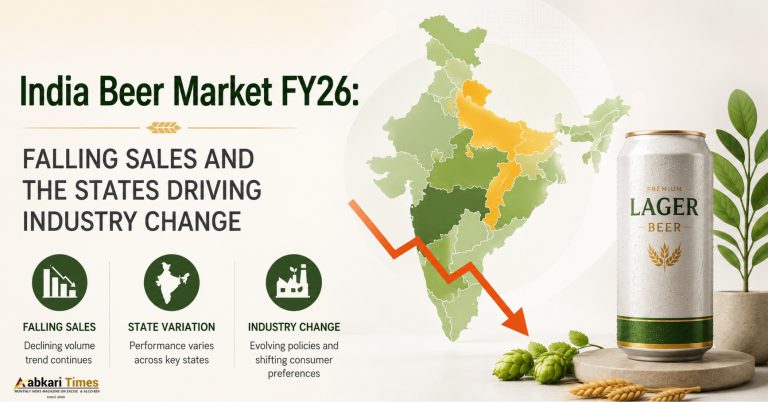
The India beer market is entering a new phase where regional trends are shaping the future more than national averages. While India continues to remain one of the fastest-growing beer markets in the Asia-Pacific region, the industry’s real story in FY26 is unfolding state by state.
India consumed nearly 345 million cases of beer in 2023, and industry estimates suggest the market could continue growing at a CAGR of over 6% in the coming years. Urbanisation, rising disposable incomes, premium lifestyle preferences and a large young adult population continue to support long-term demand.
However, the market is no longer growing uniformly across the country.
Instead, four states — Telangana, Karnataka, Maharashtra and West Bengal — are increasingly influencing beer industry performance through their impact on volumes, taxation, pricing, premiumisation and profitability.
 Amrut Distilleries’ Sales Growth to Remain Under Pressure Until 2030 Amid Limited Whisky Supply and Cheaper Scotch Imports
 Japan Cuts Beer Taxes, Making Regular Beer Cheaper from October 2026
Together, these markets provide a clearer picture of where India’s beer business stands in FY26 and where it may be heading next.
Telangana Remains India’s Largest Beer Market Despite Sales Pressure
Telangana has long been one of India’s biggest beer-consuming states, driven largely by Hyderabad’s urban workforce, IT sector and strong retail demand.
The state typically records monthly beer sales between 45 lakh and 55 lakh cases, making it one of the country’s most important volume markets for brewers.
In FY24, Telangana reportedly sold around 54.8 million cases of beer. That number declined to nearly 53.1 million cases in FY25, reflecting a slowdown in market momentum.
While the decline appeared manageable initially, deeper challenges soon emerged.
Industry reports indicated that pending dues owed to liquor companies crossed ₹3,900 crore, while pricing disputes between brewers and the state impacted supplies in several periods.
The pressure became more visible in FY26.
Beer sales reportedly dropped nearly 9% year-on-year, falling from 536.13 lakh cases to 387.34 lakh cases, even as overall liquor revenues touched a record ₹40,209 crore.
At the same time, rising retail prices also affected consumption patterns. In several outlets, the price of a 650 ml beer bottle increased from around ₹150 to nearly ₹180, encouraging some consumers to shift toward stronger spirits instead of beer.
For the industry, Telangana remains essential because of its scale, but the market is also becoming an example of how high volumes alone may no longer guarantee sustainable profitability.
Karnataka Faces Sharp Beer Sales Decline Amid Higher Taxation
If Telangana represents scale, Karnataka represents influence.
Bengaluru has played a major role in shaping India’s modern beer culture, from craft breweries and premium beer trends to urban pub consumption.
Many beer trends that later expanded across India first gained popularity in Karnataka.
But FY25 presented significant challenges for the state’s beer market.
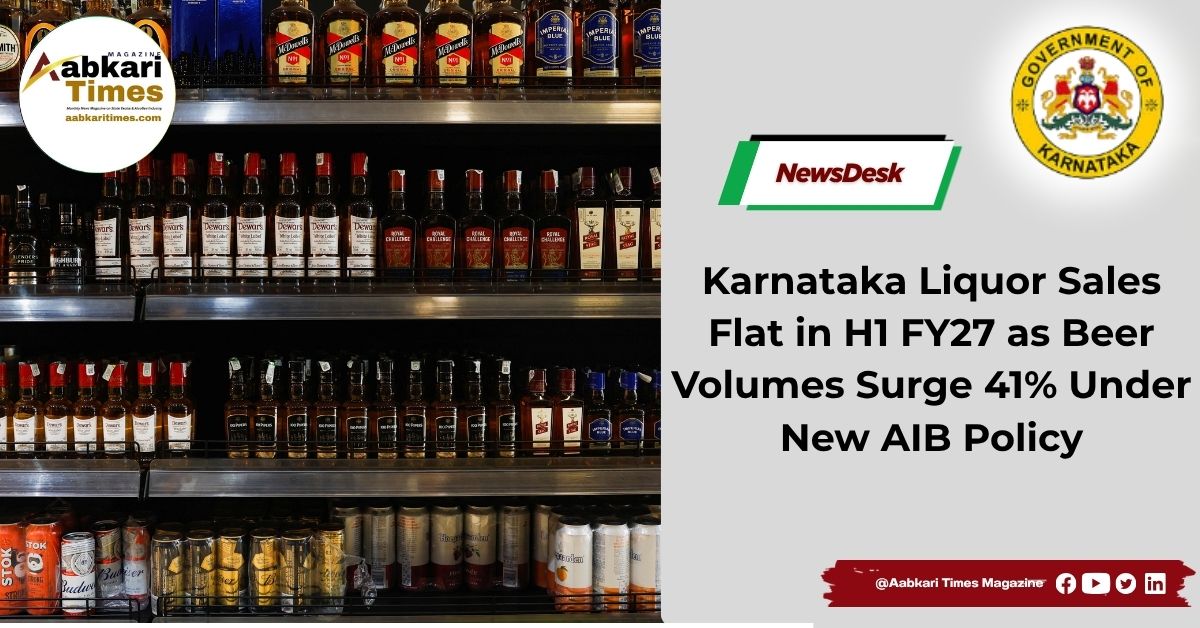
Beer sales in Karnataka reportedly declined by more than 18% during the first half of 2025. Between January and June, sales fell from nearly 257 lakh carton boxes to around 209.9 lakh cartons.
January recorded the steepest fall, with volumes dropping over 30%, while summer months such as April and May — usually considered peak beer season — also witnessed notable declines.
The slowdown followed multiple increases in additional excise duties and licence fees over the past two years.
Interestingly, even as beer consumption weakened, Karnataka’s excise collections continued to rise.
This has made Karnataka one of the most closely watched beer markets in India. The state is effectively testing how far taxation and price hikes can impact consumer demand in a mature beer-drinking market.
For brewers and suppliers, Karnataka’s performance is being seen as an important indicator of future pricing sensitivity across India.
Maharashtra Emerges as India’s Premium Beer Growth Hub
Unlike Telangana and Karnataka, Maharashtra’s importance lies less in sheer beer volume and more in premiumisation.
The state’s major urban centres — including Mumbai, Pune and Nashik — are home to large numbers of high-income consumers and premium hospitality outlets.
Maharashtra also remains India’s richest state by GSDP, with an economy estimated at around ₹42.67 lakh crore in FY25.
That economic strength is increasingly supporting growth in premium beer categories.
Industry players continue to treat Maharashtra as a key market for imported labels, premium lagers, wheat beers and experimental launches.
Several brewers now use Maharashtra as a testing ground for premium products before introducing them nationally.
The trend reflects a broader shift in India’s alco-beverage sector, where younger urban consumers are showing greater willingness to pay for differentiated drinking experiences rather than simply increasing consumption volumes.
For suppliers and manufacturers, this trend is also boosting demand for specialised packaging, imported ingredients, premium glass bottles and value-added brewing inputs.
As a result, Maharashtra is increasingly being viewed as one of India’s most important markets for future value-led beer growth.
West Bengal Continues to Offer Stability for the Beer Industry
West Bengal may not generate the same headlines as Telangana or Karnataka, but it remains one of India’s most stable and dependable alcohol markets.
The state consistently ranks among the country’s major consuming regions, supported by strong urban demand, a dense retail network and relatively stable consumption patterns.
Excise collections have remained healthy in recent years, including strong festive-period sales that generated significant state revenues.
For brewers, West Bengal’s biggest advantage is predictability.
Unlike some southern states that have experienced repeated pricing disputes, supply interruptions or frequent policy changes, West Bengal has largely maintained a stable operating environment.
That stability allows companies to plan distribution, inventory management and long-term investments with greater confidence.
In an industry increasingly affected by regulatory uncertainty, operational consistency itself has become a major advantage.
India Beer Market FY26 Is Becoming Increasingly Regional
One of the biggest takeaways from the India beer market in FY26 is that industry growth is no longer being driven by a single national trend.
Each leading state is now shaping the market differently.
- Telangana continues to highlight the importance of scale, even as profitability pressures increase.
- Karnataka is demonstrating how higher taxation can influence beer consumption behaviour.
- Maharashtra is emerging as the centre of premiumisation and value-driven growth.
- West Bengal continues to prove the importance of stability and predictable market conditions.
For brewers, marketers and suppliers, these four states now offer a more realistic picture of India’s beer industry than national growth numbers alone.
The next phase of India’s beer business will likely depend not only on how much beer consumers drink, but also on where they drink it, how they spend, and which states create the most sustainable conditions for long-term growth.
About the Author