
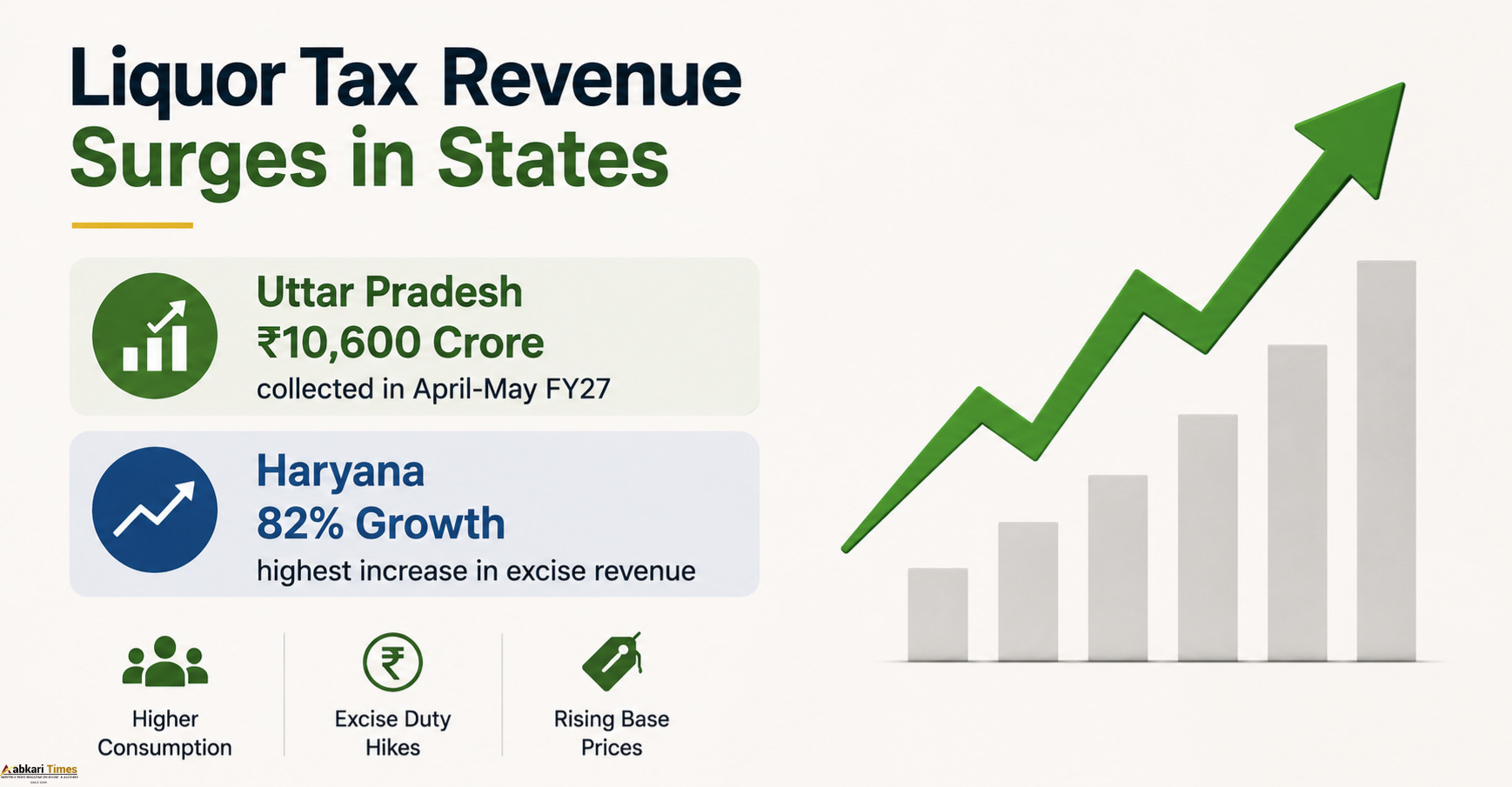
State governments across India have reported a sharp rise in liquor-related tax collections, with excise revenues increasing significantly during the first two months of FY2026-27. The growth has been driven by higher alcohol consumption, increases in state excise duties, and rising base prices charged by liquor manufacturers.
According to data compiled from monthly financial indicators released by the Comptroller and Auditor General (CAG), Uttar Pradesh emerged as the largest contributor to state excise revenue, while Haryana posted the highest year-on-year growth rate.
Uttar Pradesh Tops Excise Revenue Collection
Uttar Pradesh collected more than ₹10,600 crore in excise revenue during April and May of FY2026-27, marking an increase of nearly 9 percent compared with the same period last year.
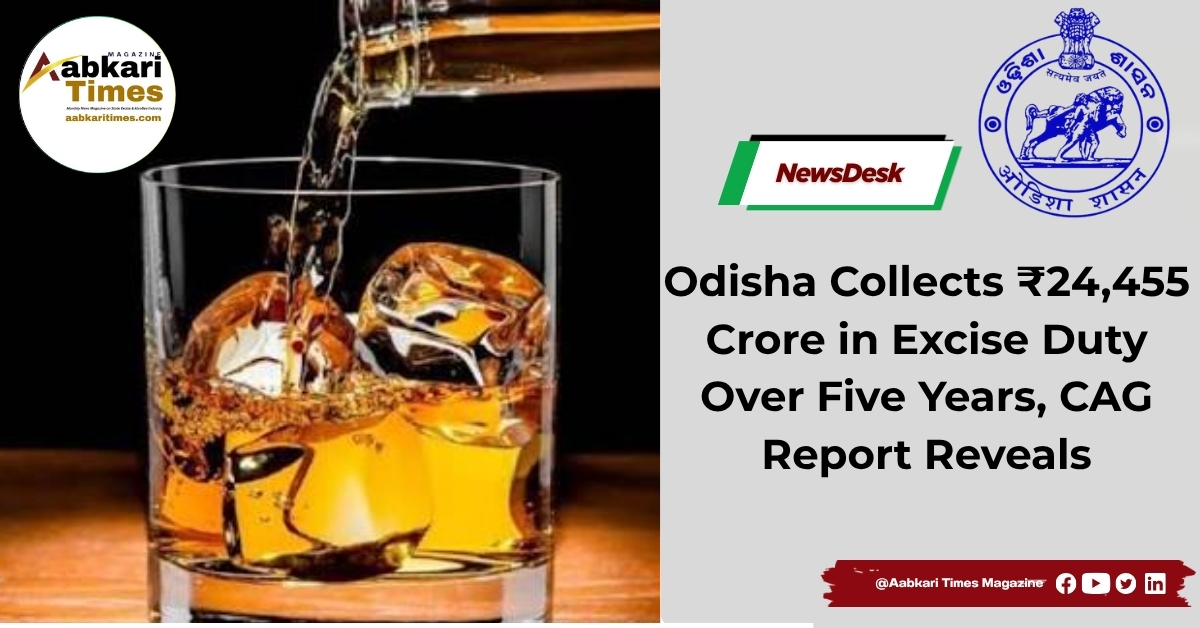
 Odisha Collects ₹24,455 Crore in Excise Duty Over Five Years, CAG Report Reveals
 Nasha Mukt Yuva for Viksit Bharat UP Prohibition Department Holds Youth Awareness Seminar at AKTU Lucknow
The state’s strong performance reinforces its position as India’s largest liquor tax market, where alcohol continues to be one of the biggest contributors to government revenue.
Haryana Registers Record Growth
While Uttar Pradesh led in total collections, Haryana recorded the fastest growth, with excise revenue rising by over 82 percent year-on-year to more than ₹2,300 crore during the April-May period.
Among other major states, Karnataka ranked second in overall collections, while Kerala recorded one of the strongest percentage increases.
What’s Driving the Revenue Boom?
Industry experts attribute the sharp rise in excise collections to three major factors:
- Around 14 percent growth in alcohol consumption
- Higher excise duty rates introduced by several state governments
- Increase in manufacturers’ base prices, which raised the taxable value of alcoholic beverages
Together, these factors have significantly boosted state revenues from liquor sales.
Why Liquor Taxes Matter to States
Alcohol meant for human consumption remains outside the Goods and Services Tax (GST) framework. This allows each state and Union Territory to independently determine its own taxation policy.
States generate revenue through multiple levies, including:
- State excise duty on production
- Value Added Tax (VAT) on sales
- Additional cess and surcharges
These taxes may be charged either as a percentage of product value or as a fixed amount per litre, giving states flexibility to revise tax structures according to their fiscal needs.
States Continue to Reform Alcohol Tax Policies
Several states are also experimenting with new taxation models.
Karnataka recently became the first state in India to adopt an Alcohol-in-Beverage (AIB)-based excise system, linking taxes more closely to alcohol content. Meanwhile, Kerala has proposed lowering taxes on low-alcohol beverages to encourage consumption of lighter drinks.
Excise Duty Remains a Key Revenue Source
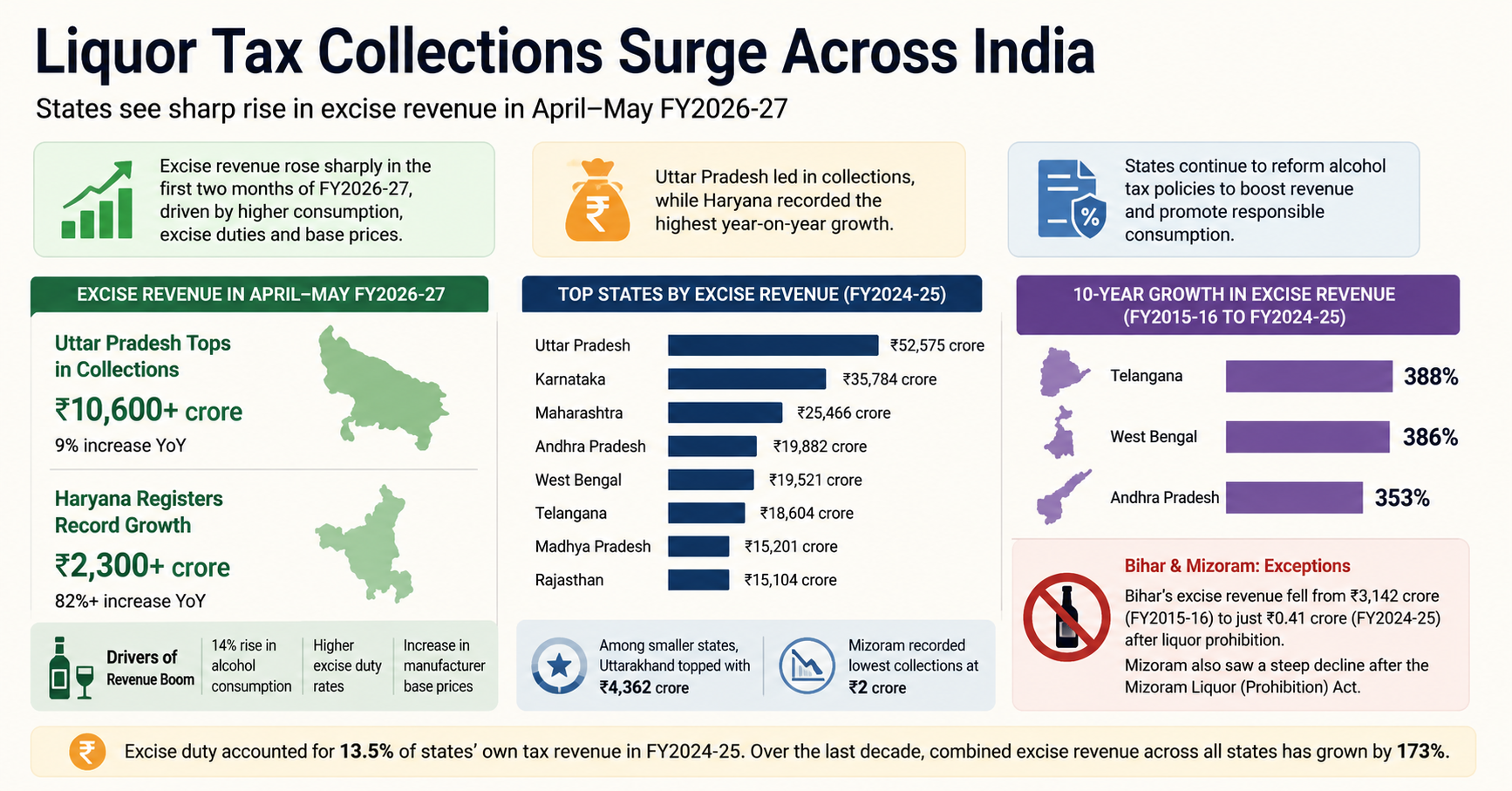
The CAG’s State Finances 2024-25 report shows that state excise duty accounted for approximately 13.5 percent of states’ own tax revenue during FY2024-25.
The highest excise collections during FY2024-25 were recorded by:
- Uttar Pradesh – ₹52,575 crore
- Karnataka – ₹35,784 crore
- Maharashtra – ₹25,466 crore
- Andhra Pradesh – ₹19,882 crore
- West Bengal – ₹19,521 crore
- Telangana – ₹18,604 crore
- Madhya Pradesh – ₹15,201 crore
- Rajasthan – ₹15,104 crore
Among smaller states, Uttarakhand reported the highest excise receipts at ₹4,362 crore, while Mizoram recorded only ₹2 crore.
Excise Collections Have Grown Strongly Over the Past Decade
Over the last ten years, combined excise revenue across all states has increased by 173 percent, highlighting the growing importance of alcohol taxation in state finances.
Telangana recorded the strongest long-term growth, with excise collections rising 388 percent between FY2015-16 and FY2024-25. West Bengal followed with 386 percent growth, while Andhra Pradesh registered an increase of 353 percent during the same period.
Bihar and Mizoram Remain Exceptions
Unlike most states, Bihar’s excise revenue collapsed after the implementation of complete liquor prohibition in April 2016. Collections fell from ₹3,142 crore in FY2015-16 to just ₹30 crore in FY2016-17, and further declined to ₹0.41 crore in FY2024-25.
Mizoram also witnessed a steep decline in liquor-related tax revenue following the enforcement of the Mizoram Liquor (Prohibition) Act.
About the Author