
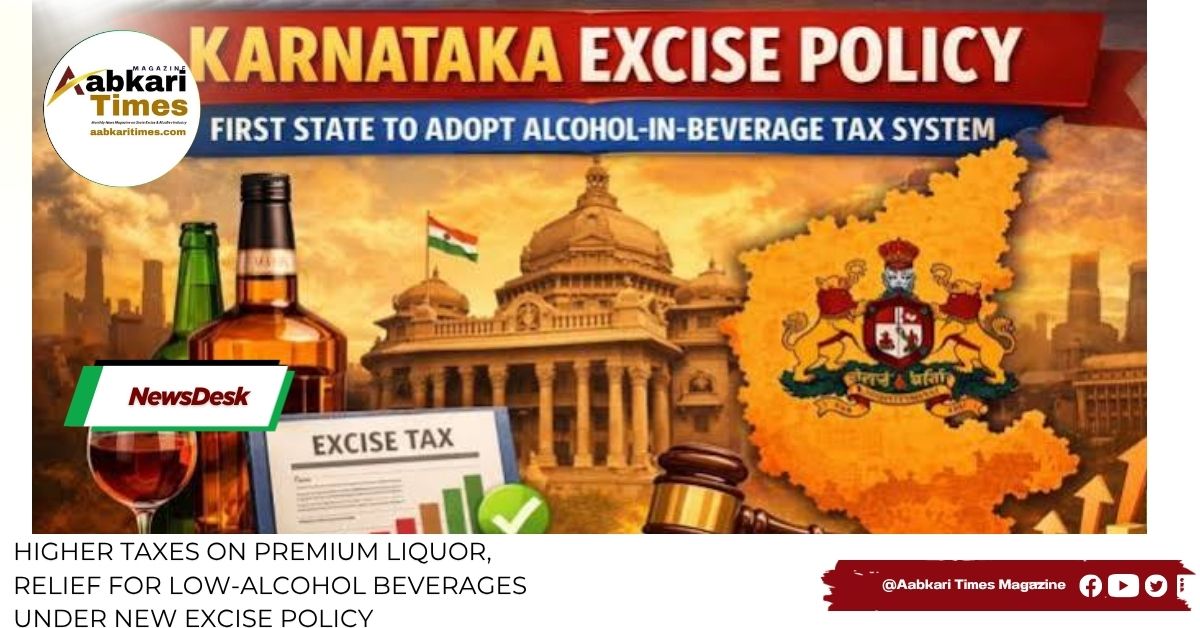
The Karnataka Government has notified a new draft excise policy that introduces significant changes to the state’s alcohol taxation framework.
Under the proposed policy, taxes on alcoholic beverages will now be determined based on three key factors: alcohol content, product category, and declared market value. The government’s objective is to create a more rational tax structure in which stronger and more expensive alcoholic beverages attract higher taxes, while lower-strength products face a comparatively lighter tax burden.
The draft policy specifically increases the tax burden on the two largest-selling categories in the state—Indian Made Liquor (IML) and beer. At the same time, alcoholic products manufactured for defence supplies and export markets have been granted relatively favorable treatment under the proposed framework.
 Odisha Collects ₹24,455 Crore in Excise Duty Over Five Years, CAG Report Reveals
 Nasha Mukt Yuva for Viksit Bharat UP Prohibition Department Holds Youth Awareness Seminar at AKTU Lucknow
According to the government, the revised taxation system is intended to improve revenue collection while encouraging a shift toward lower-alcohol products and aligning excise duties more closely with the social costs associated with alcohol consumption. The policy forms part of Karnataka’s broader excise reform agenda aimed at making the sector more transparent, efficient, and evidence-based.
New Tax Structure for IML and Beer Announced
Under the newly notified excise framework, Indian Made Liquor (IML) containing 42.8% alcohol by volume (ABV) will attract an excise duty of ₹50 per bulk litre in both the civil and defence segments.
For beer, taxation will now be directly linked to its alcohol content:
- Beer with up to 5% alcohol content: ₹12 per bulk litre
- Beer with more than 5% and up to 8% alcohol content: ₹20 per bulk litre
The new policy also revises the structure of Additional Excise Duty (AED) and Additional Countervailing Duty (ACD) under Schedule-D. These duties will now be linked to the retail price of alcoholic beverages.
For civil and imported IML, the combined duty structure will range from ₹297 per bulk litre for lower-priced products and can increase to ₹3,000 per bulk litre for premium liquor priced above ₹20,001.
According to the government, the revised taxation model is designed to create a more progressive excise system in which higher-priced and premium alcoholic beverages bear a larger tax burden, while lower-priced products are taxed at comparatively moderate rates. The move is part of Karnataka’s broader excise reform initiative aimed at improving revenue efficiency, transparency, and alignment with public policy objectives.
Stricter Licensing Rules and Additional Fees Introduced
Alongside changes to the tax structure, the Karnataka Government has also introduced significant revisions to its licensing regulations under the new excise policy.
The reforms include provisions for:
- Licence transfer charges
- An additional 15% licence fee
- Permanent label approval fees
The applicable fee structure will vary depending on whether the product is intended for sale within Karnataka, outside the state, or in international export markets.
According to the government, these measures are expected to strengthen regulatory oversight, increase state revenue, and create a more transparent and rational excise administration system. The revised framework is also intended to help regulate excessive alcohol consumption while ensuring better compliance across the industry.
For the alcohol industry, however, the policy sends a clear signal that premium and high-strength alcoholic beverages are likely to become more expensive, as they will face higher taxes and regulatory costs. In contrast, lower-strength and lower-priced products may receive a relative advantage, reflecting the government’s objective of aligning taxation more closely with alcohol content and social impact.
The proposed changes form part of Karnataka’s broader excise reform agenda, which seeks to balance revenue generation, public health considerations, and industry development through a more scientific and progressive regulatory framework.
Higher Taxes on Beer and Wine Under New Excise Policy
Under the revised excise framework, the Karnataka Government has imposed significantly higher taxes on beer based on its pricing category.
For beer priced at ₹300 or above per bottle, the tax burden has been sharply increased. In the highest category, excise duty may go up to 200%, along with Additional Excise Duty (AED) and Additional Countervailing Duty (ACD).
For beer priced at ₹40 per bulk litre or above, the government will levy 185% of the declared value or ₹120 per bulk litre, whichever is higher, as excise duty.
The new policy also rationalises taxation across different alcoholic beverage categories. Fortified wines, fruit wines, and low-alcohol beverages will continue to attract concessional rates to promote diversification in the segment.
Imported foreign liquor will remain exempt from standard excise duty (AED structure), but will still attract applicable countervailing duties, bringing it in line with domestic tax treatment.
According to officials, the objective of the revised structure is to ensure a more progressive taxation system where premium and high-value alcoholic beverages bear a significantly higher tax burden, while lower-priced and low-alcohol products are comparatively less impacted.
Industry Raises Concerns Over Karnataka Excise Policy Reform
The Confederation of Indian Alcoholic Beverage Companies (CIABC) has raised concerns over the Karnataka government’s proposed new excise policy, calling for a more balanced regulatory approach that does not disproportionately favor or disadvantage any single segment of the industry.
CIABC Director General Anant S. Iyer stated that the policy should not be designed in a way that creates excessive advantage for any one category. He emphasized that the proposed Alcohol-in-Beverage (AIB) framework is a constructive step toward a more rational taxation system, but it must ensure stability and fairness across consumption patterns, industry operations, and government revenue.
According to CIABC, the implementation of the new policy comes at a time when IMFL (Indian Made Foreign Liquor) demand has already shown volatility, with an estimated decline of around 6% in the segment in May 2025 following earlier tax revisions. Industry representatives warned that additional Excise Duty (AED) on this category could further widen price gaps and create distortions in demand.
The association noted that IMFL contributes significantly more to excise revenue compared to beer, and any disproportionate tax increase could impact manufacturing, distribution, bottling operations, and allied agricultural sectors linked to the industry.
While acknowledging the government’s intent to promote a more scientific taxation structure and improve public health outcomes, CIABC stressed that beer taxation increases—estimated at 4 to 6 times in certain cases—may not translate into higher revenues if consumption shifts or demand contracts.
The industry body also cautioned that regional inconsistencies or excessive price hikes could lead to market imbalances and encourage illicit trade if not carefully managed.
CIABC has urged the government to engage in continued dialogue with stakeholders to develop a final excise policy that balances consumer affordability, industry sustainability, and state revenue objectives, ensuring long-term stability for all segments of the alcoholic beverage sector.
About the Author