
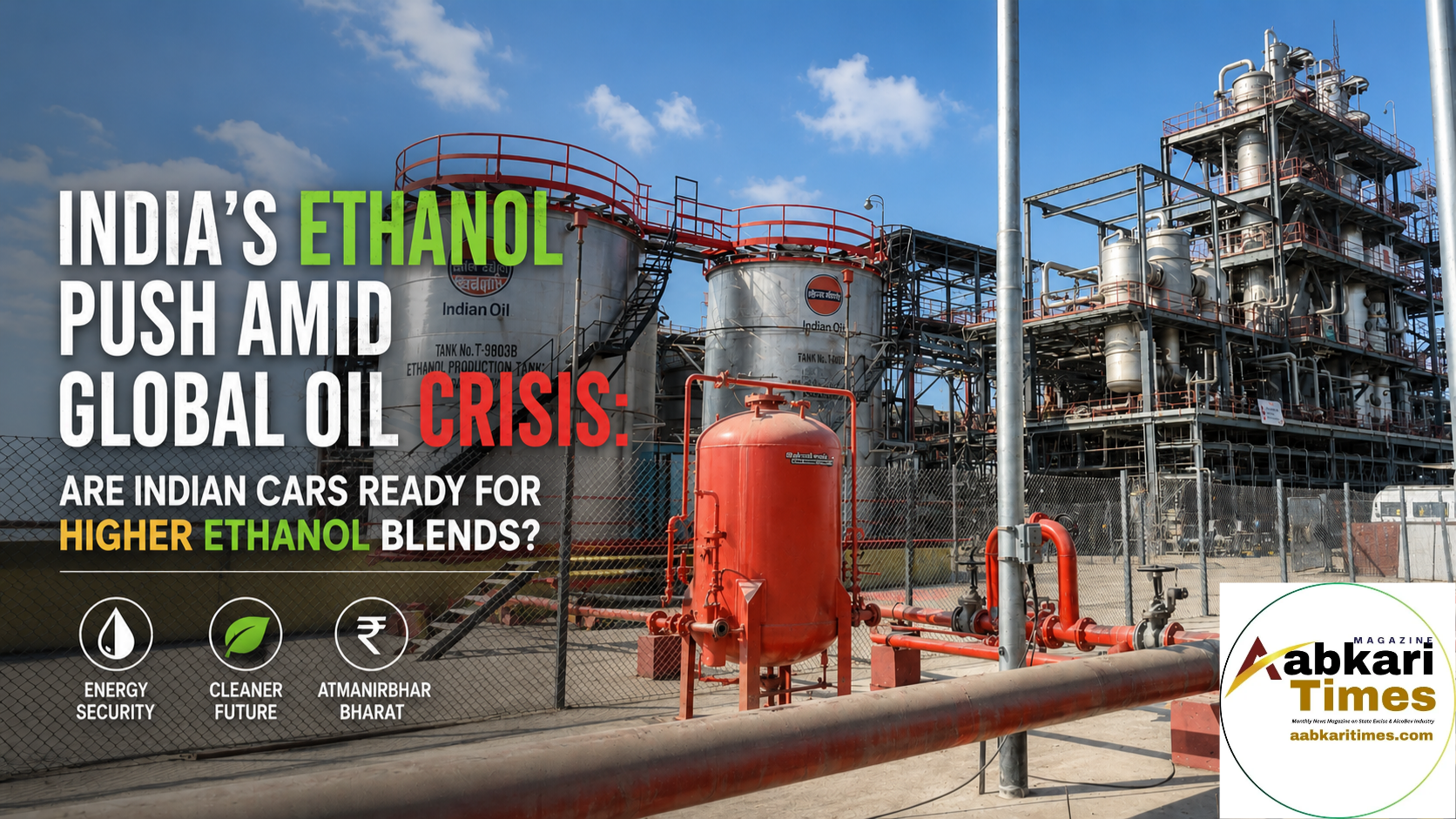
India’s growing focus on ethanol-blended fuel has gained fresh momentum amid the ongoing global oil crisis and rising crude prices. With geopolitical tensions in West Asia disrupting oil supplies and increasing import costs, the Indian government is accelerating its transition toward alternative fuels such as ethanol, electric mobility, and biogas to strengthen the country’s energy security.
While fuel prices remained relatively stable for months, reports suggested that oil marketing companies were facing daily under-recoveries of nearly ₹1,000–1,700 crore. The recent hike in petrol and diesel prices has once again highlighted India’s heavy dependence on imported crude oil and the urgent need for long-term energy alternatives.
Why India Is Increasing Ethanol Blending in Petrol
India has already implemented a nationwide E20 fuel policy, meaning standard petrol now contains 20 percent ethanol. The move is aimed at reducing crude oil imports, supporting domestic agriculture, and cutting carbon emissions.
Unlike crude oil, ethanol is largely produced domestically from agricultural feedstocks such as maize, sugarcane, rice, and agricultural waste. According to the Petroleum Ministry, nearly 47 percent of India’s ethanol production now comes from maize, which requires significantly less water than sugarcane cultivation.
The government is also investing in second-generation (Gen-2) ethanol projects that use bamboo, crop residue, and other biomass waste to produce fuel more sustainably. Facilities like the Numaligarh Refinery project in Assam are already showing promising results.
Impact of Ethanol on Vehicle Performance
Although ethanol blending offers economic and environmental benefits, not all vehicles are fully prepared for higher ethanol concentrations.
Ethanol is less energy-dense than petrol, which means older petrol vehicles often experience reduced fuel efficiency. In many cases, mileage losses range between 10–15 percent, especially in cars designed before ethanol blending became common.
Older engines may also face issues because ethanol has corrosive properties that can affect rubber hoses, seals, and fuel system components. However, modern vehicles equipped with advanced technologies such as knock sensors, variable valve timing, and electronic ignition systems are better capable of handling ethanol blends with minimal performance loss.
→ India’s Ethanol Supply Reaches 895 Crore Litres as Grain-Based Feedstocks Gain Share→ Sonbhadra Set to Become a Major Maize Production Hub, Boosting Ethanol Industry Growth
Most passenger vehicles manufactured in India after 2023 are compatible with E20 fuel, while several automakers have introduced retrofit kits for older models.
Government Considering Higher Ethanol Blends
India may soon move beyond E20 fuel blending. Reports suggest the government is evaluating ethanol blends ranging between 22 percent and 25 percent as part of its long-term energy strategy. However, higher ethanol blends could create challenges for vehicles manufactured before 2019, many of which were originally engineered for E10 fuel. Without modifications or retrofitting, these vehicles may suffer from engine wear, fuel system damage, and reduced efficiency. To address this, automakers are increasingly exploring flex-fuel technology.
What Are Flex-Fuel Vehicles?
Flex-fuel vehicles are designed to operate on multiple fuel blends, including petrol mixed with high concentrations of ethanol. These vehicles can run on E85 (85 percent ethanol) or even E100 fuel. In practice, E100 fuel contains approximately 98 percent ethanol along with small quantities of petrol and additives. Since ethanol delivers lower energy output compared to petrol, higher ethanol blends generally consume more fuel. To offset this, the government is expected to price E85 fuel 15–20 percent lower than standard E20 petrol.
Several major automobile manufacturers, including Maruti Suzuki and Tata Motors, are reportedly preparing to launch flex-fuel models in India. Brazil’s successful adoption of ethanol-powered vehicles is often cited as a model for India’s future roadmap.
Flex-Fuel Hybrids Could Be the Future
Industry experts believe the next major innovation could be flex-fuel hybrid (FFH) vehicles. These combine hybrid-electric technology with the ability to run on high-ethanol fuel blends, delivering both improved fuel efficiency and lower emissions.
At the Japan Mobility Show, Suzuki showcased a production-ready prototype of a flex-fuel hybrid version of the Fronx. Government officials and industry leaders see FFHs as a practical middle ground between conventional internal combustion engines and fully electric vehicles.
Electric Vehicles Alone Cannot Solve India’s Energy Challenge
While electric vehicle adoption is growing rapidly across India, experts believe EVs alone cannot immediately replace the country’s massive petrol and CNG vehicle fleet. India also faces supply-chain risks in the EV ecosystem, particularly due to China’s dominance in rare earth materials and battery components. Although companies such as Ola Electric are investing in domestic battery manufacturing, large-scale electrification will take time. As a result, ethanol, biogas, and hybrid technologies are expected to play a critical transitional role in reducing India’s fuel import dependency.
Conclusion
India’s aggressive push toward ethanol-blended fuel reflects the country’s urgent need to improve energy security amid volatile global oil markets. While E20 petrol has already become standard, the shift toward higher ethanol blends and flex-fuel vehicles appears inevitable. Modern vehicles are increasingly capable of handling ethanol-rich fuels, but older cars may require upgrades to avoid performance and durability issues. As India balances energy independence, environmental goals, and economic realities, flex-fuel and hybrid technologies could emerge as key pillars of the country’s transportation future.
About the Author