
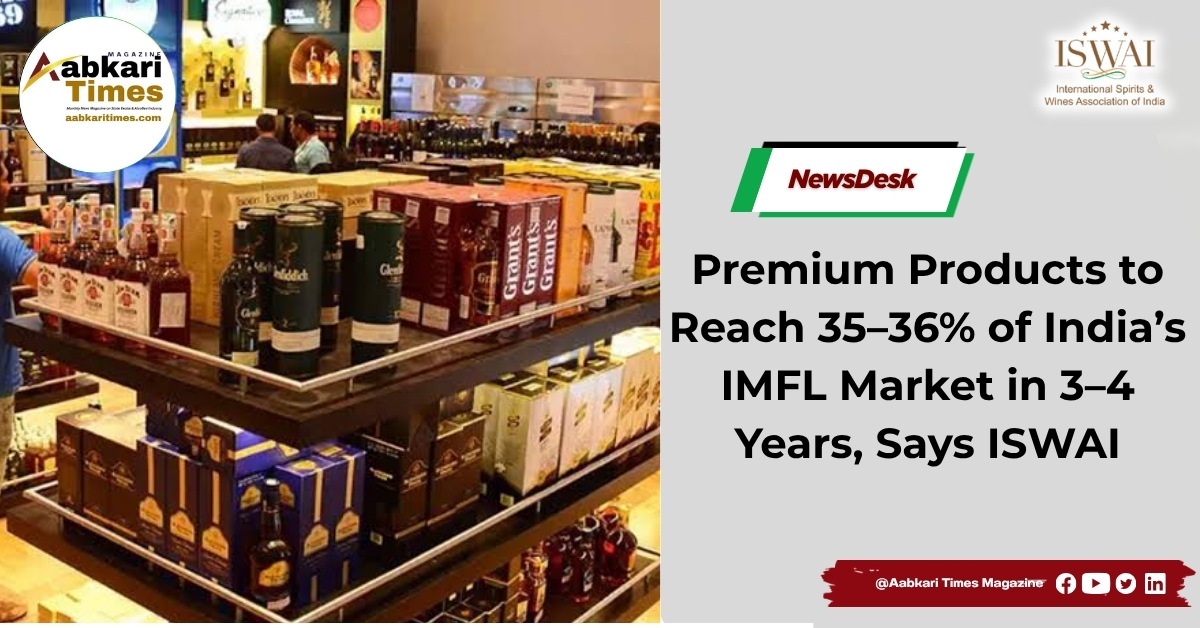
Premium alcoholic beverages are expected to account for 35–36% of India’s Indian-Made Foreign Liquor (IMFL) market over the next three to four years, up from more than 32% currently, as consumers increasingly shift towards higher-value products, according to the International Spirits and Wines Association of India (ISWAI). The industry body believes that premiumisation, supported by evolving consumer preferences, improved product accessibility and trade agreements, will remain a major growth driver for India’s alcoholic beverage industry.
 ISWAI Chief Executive Officer Sanjit Padhi said the premiumisation trend has strengthened significantly, with premium products’ share rising from approximately 29% three to four years ago to over 32% at present. According to Padhi, consumers are not necessarily increasing their overall alcohol consumption but are increasingly choosing products at higher price points. This shift towards premium offerings is also creating opportunities for manufacturers to improve revenue realisation and for state governments to enhance excise revenue collections.
The India-UK Free Trade Agreement (FTA), which became effective in July 2026, is expected to support premiumisation by making imported Scotch whisky more affordable as an input for Indian liquor manufacturers. Padhi noted that approximately 79% of Scotch whisky imported from the United Kingdom into India arrives in bulk and is used by domestic manufacturers for blending in IMFL products. Lower import duties could help producers access higher-quality Scotch at more competitive costs, enabling them to improve blends, strengthen product quality and expand their premium portfolios.
 Telangana Hikes Foreign Liquor Prices by Up to 6%; Consumers to Pay ₹30–₹100 More Per Bottle
 Old Monk Maker Says Maharashtra Has Lost ₹300 Crore in Excise Revenue Since Khopoli Plant Shutdown
However, Padhi said the benefits of reduced import duties may not necessarily translate into immediate retail price cuts. Instead, the agreement could improve the overall value proposition for consumers through better-quality products and more premium offerings. Similar trade agreements that reduce tariffs on imported spirits could encourage product innovation and give Indian consumers access to a wider range of international beverages, although their impact on overall consumption volumes may remain limited.
According to ISWAI, stable and predictable excise policies, modern retail infrastructure and rational taxation are essential to accelerate premiumisation in India. Better-designed retail outlets can help consumers explore different brands, understand product categories and consider premium options at slightly higher price points. Padhi also highlighted that reducing the price gap between mass-market and premium products through appropriate tax measures has helped improve product mix and revenue collection in some states.
The premiumisation trend is extending beyond whisky into categories such as gin, tequila and Irish whiskey. Padhi said Irish whiskey volumes in India have doubled over the past three years and are approaching 800,000 cases, reflecting growing interest in international spirits categories. Consumers in smaller cities are also increasingly experimenting with premium and newer alcoholic beverage offerings, a trend that was previously more concentrated in metropolitan markets.
ISWAI’s latest report, Economic Value of the Indian Alcoholic Beverage Industry 2026, estimates that India’s alcoholic beverage market was valued at ₹6.2 lakh crore, or approximately USD 71 billion, in calendar year 2025. The market represented around 1.8% of India’s nominal GDP. Total beverage alcohol volumes reached approximately 8,435 lakh cases, recording a compound annual growth rate (CAGR) of 4.9% between 2022 and 2025. However, volume growth is projected to moderate to around 3.9% CAGR through 2030 as the market increasingly shifts towards value-driven expansion.

Economic growth, employment generation, domestic manufacturing and smart-city development are creating new consumption centres beyond India’s traditional metropolitan markets. Demographic changes are also influencing demand, with estimates suggesting that at least 20 million people enter the legal drinking age each year. Increasing workforce participation among women and broader social and economic changes are further diversifying the consumer base.
ISWAI represents international premium spirits and wine brands in India. The association expects premiumisation to remain a defining feature of the country’s alcoholic beverage market, driven by changing consumer aspirations, improved access to premium products, product innovation and a more favourable policy environment. The shift from volume-led growth to value-driven expansion is expected to create opportunities for manufacturers while influencing the future trajectory of India’s IMFL segment.
About the Author