
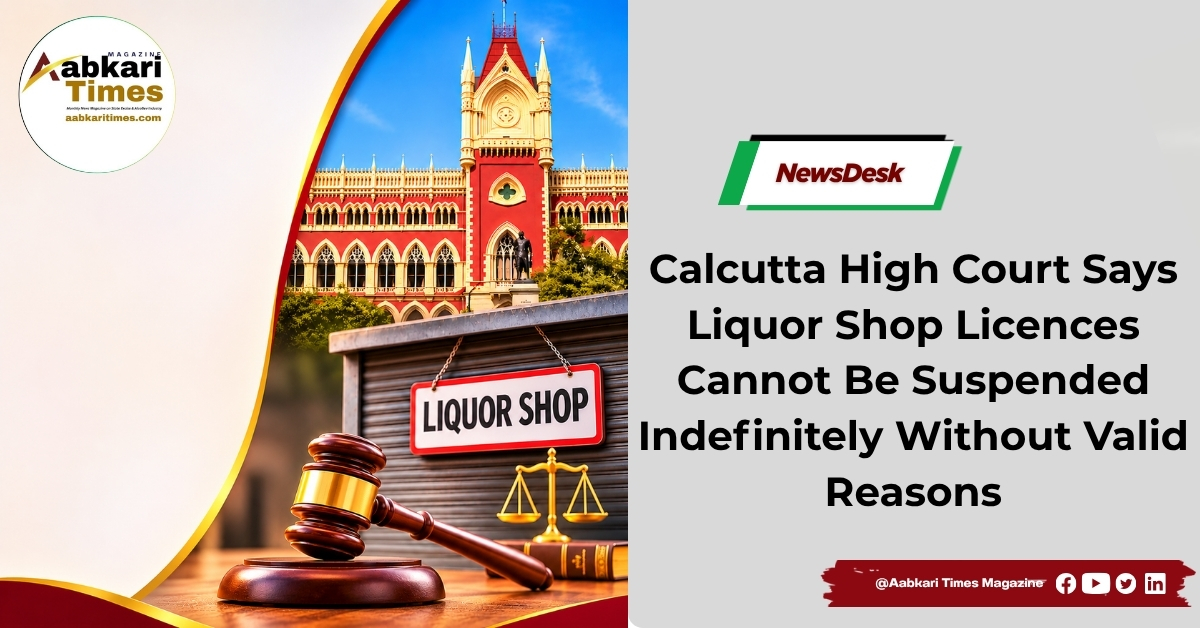
The Calcutta High Court has ruled that the West Bengal government cannot keep liquor shops closed indefinitely without providing valid and legally sustainable reasons. The court observed that although liquor licence holders do not have a fundamental right to operate liquor shops, the legal privilege granted to them cannot be withdrawn or suspended without justification and adherence to established legal procedures.
A division bench comprising Justices Arijit Banerjee and Apurba Sinha Ray delivered the observation while hearing an appeal filed by liquor licence holders whose temporary shop licences were suspended in March 2019 during the Lok Sabha elections. Although the election period had ended, the authorities did not allow the affected shops to reopen, resulting in the prolonged suspension of their licences.
In its November 13 order, the court noted that the Bengal Excise Act, 1909, and the rules framed under it clearly specify the circumstances in which temporary liquor licences can be suspended or cancelled. However, the state authorities had failed to establish any default or similar misconduct by the licence holders that would justify either the initial suspension or its continuation after the elections.
 Radico Khaitan Appoints Dilip K. Banthiya as Executive Director and CFO; Elevates Saket Somani to Deputy CFO
 Kerala Excise Freezes New Liquor Licences Amid Policy Vacuum, Excise Commissioner Transferred
The bench emphasised that the absence of a fundamental right to operate a liquor business does not give the government unlimited authority to withdraw an existing legal privilege. Any decision affecting licence holders must be supported by a valid reason and comply with the applicable statutory provisions.
The court further highlighted the constitutional principle that administrative procedures must be just, fair and reasonable, and consistent with established principles of law. A restriction imposed during a specific situation, such as an election, cannot automatically continue after the circumstances requiring it have ceased to exist without an appropriate legal basis.
The ruling highlights the importance of procedural fairness and accountability in the administration of liquor licences. It also clarifies that excise authorities must follow the provisions of the applicable law when suspending or cancelling temporary licences, rather than continuing restrictions without demonstrating sufficient grounds.
The decision reinforces the principle that government action affecting licensed businesses must remain within the framework of law.
About the Author