
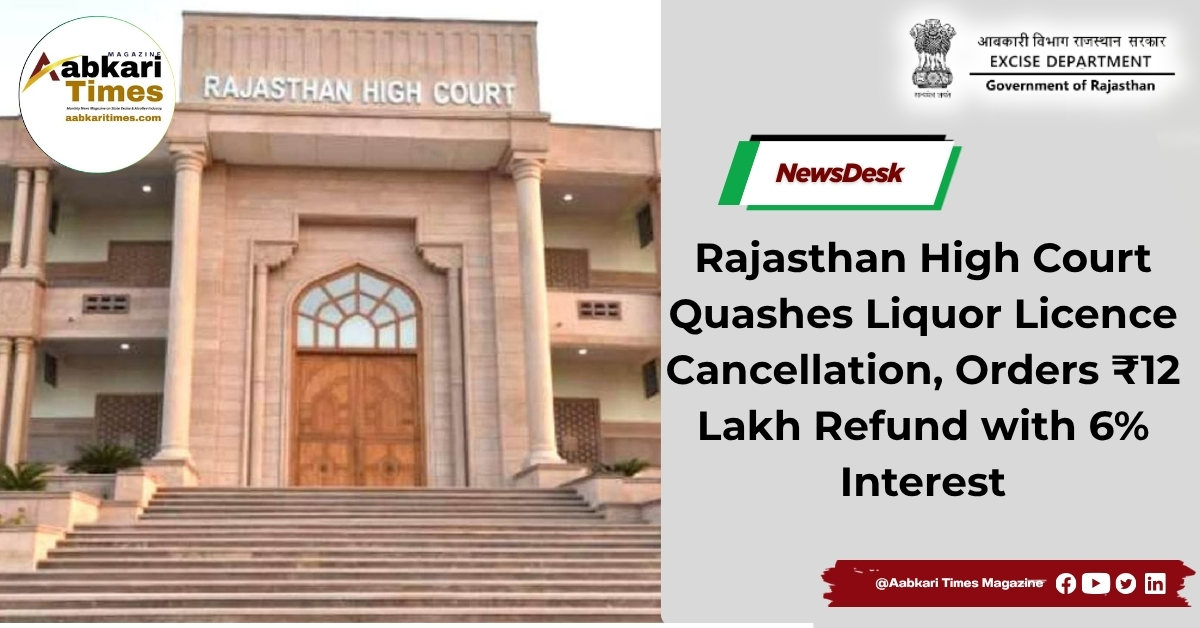
The Rajasthan High Court has quashed the cancellation of a liquor shop licence awarded to a woman through a lottery and directed the Excise Department to refund her ₹12 lakh deposit with 6% annual interest. The Court ruled that the allegation of concealing a criminal case was unsupported by the record, as no criminal case was registered against her on the date she submitted her licence application.
Justice Anand Sharma observed that merely providing an opportunity to a person to present their case is not sufficient; an administrative order must also be supported by legally justified reasons. The Court found that the charge sheet naming the woman as an accused was filed only after the provisional sanction of the liquor licence had been issued.
The case dates back to 2016, when the Rajasthan Excise Department invited applications for liquor shop licences. The woman applied, won the lottery and received provisional approval after depositing ₹12 lakh, equivalent to 12.5% of the allotment price. Subsequently, the unsuccessful candidate placed on the reserve list complained that she had concealed a criminal case registered under the Rajasthan Excise Act, 1950.

The matter originated from a 2015 FIR concerning the alleged seizure of liquor from a vehicle owned by the woman. However, she was not named as an accused in the original FIR. She was named for the first time in a charge sheet filed four days after the provisional licence sanction. Despite this timeline, the District Excise Officer cancelled the sanction and forfeited her deposit. Her appeal before the Excise Commissioner and subsequent revision before the Rajasthan Tax Board were also rejected.
Before the High Court, her counsel argued that the applicable departmental guidelines restricted eligibility only for individuals against whom an excise or narcotics case had been registered, or who had been convicted. The counsel also relied on Section 34(d) of the Rajasthan Excise Act, arguing that cancellation after the issuance of a licence required a conviction, which had not occurred in her case.
 Kerala Government Plans Strict Action Against Bars Serving Alcohol to People Below 23
 Odisha Bans New Liquor Shops for Three Years, CM Mohan Charan Majhi Announces Zero-Tolerance Policy on Drugs
The Excise Department countered that the woman owned the vehicle involved in the incident and could not claim ignorance of the case. It maintained that a person facing an excise trial should not be permitted to hold a liquor licence.
Rejecting the department’s position, the High Court held that ownership of a vehicle involved in an incident does not automatically make its owner an accused, particularly when the person was not named in the FIR. The Court also found that the Excise Commissioner had relied on a fact not mentioned in the show-cause notice: that the woman had secured the release of her vehicle by paying a fine. It clarified that the release of a vehicle does not establish criminal culpability and described the Tax Board’s finding that her declaration was false as unfounded and perverse.
The High Court quashed the orders passed by the District Excise Officer, Excise Commissioner and Rajasthan Tax Board, declaring the forfeiture of the deposit illegal. Since the one-year licence period had already expired, the woman sought only the return of her money. The Court directed the Excise Department to refund ₹12 lakh with interest at 6% per annum within 60 days of receiving a certified copy of the order.
About the Author