
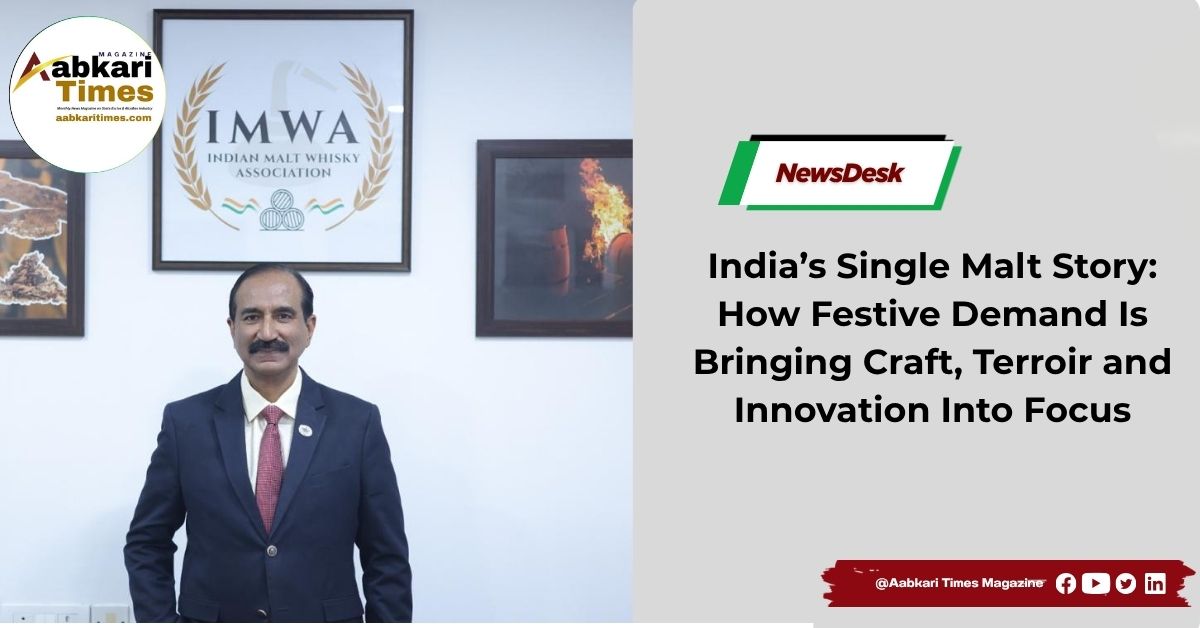
By Maj Gen (Dr) Rajesh Chopra, AVSM (Retd), Director General, The Indian Malt Whisky Association (IMWA)
India’s festive season has always been closely associated with celebration, hospitality and gifting. Increasingly, it is also becoming a moment when consumers explore premium Indian spirits, with single malt whisky finding a distinctive place in this evolving culture of consumption.
What makes this shift particularly interesting is that the Indian single malt story is no longer simply about premiumisation. It is increasingly about provenance, craftsmanship and discovering what makes a whisky distinctly Indian.
 Scotch Whisky Association Appeals Against England’s New Single Malt Whisky Rules
 Top 10 Premium Whisky Brands in India Above ₹5,000 for the Festive Season
At the heart of every single malt is the craft of transforming a few fundamental ingredients into a spirit with character. Indian distilleries are bringing their own interpretation to this process, drawing on locally available malted barley, water, distillation techniques, cask selection and, importantly, the country’s diverse climatic conditions.

India’s climate presents a very different maturation environment from traditional whisky-producing regions. Higher temperatures intensify the interaction between spirit and oak, deepening extraction, increasing evaporation, and shaping flavour development in ways cooler climates simply don’t allow. This doesn’t shorten the maturation journey itself; the spirit still needs its time in the cask to become whisky. What changes is how that time works. The heat draws out colour, tannin and character more forcefully with each thermal cycle, building essence and depth at a different pace.
This is the essence of terroir in the Indian context. India’s geographical diversity, from the cooler northern regions to the warmer southern and western parts of the country, gives the industry a natural laboratory: the same grain and process, but a different result depending on where the cask sits. A whisky matured in the Himalayan foothills develops along a different curve than one matured on the Deccan plateau or along the western coast, and distilleries are only beginning to map what that means for flavour. This regional range, more than any single factor, is what makes it possible to speak of a distinct Indian expression rather than an imitation of established styles.
This growing curiosity also makes authenticity increasingly important. As the Indian single malt category expands, consumers need greater clarity about what constitutes a genuine Indian single malt. The Indian Malt Whisky Association’s Certification Trademark is an important step in this direction. The framework establishes defined production parameters, including the use of 100% malted barley, distillation at a single Indian distillery using copper pot stills and maturation for a minimum of three years in oak casks of specified capacity. A secure holographic mark provides consumers with a visible assurance of adherence to these standards.
At the same time, innovation is broadening the category. Distillers are experimenting with maturation approaches, cask programmes, flavour profiles and limited releases while retaining the fundamentals of whisky-making. This balance between established craft and responsible experimentation is helping Indian single malts appeal to both experienced whisky drinkers and a younger generation of curious consumers.
Festive demand also has a cultural dimension. A premium bottle is increasingly viewed as more than a beverage; it can represent craftsmanship, identity and a considered gifting choice. This creates an opportunity for Indian single malts to become part of India’s contemporary luxury vocabulary, alongside other products that celebrate indigenous skill and creativity.
However, the category’s long-term success will depend on maintaining the discipline that made this growth possible. Whisky cannot be rushed. Maturation takes time, and increasing demand cannot instantly translate into additional mature inventory. Recent industry commentary has highlighted the challenge of demand growing faster than available mature stock, a tension every serious producer will need to manage carefully as festive orders climb.
The next chapter of India’s single malt journey, therefore, should not be defined merely by volumes or festive sales. It should be defined by the ability to build a category rooted in authenticity, craftsmanship and Indian character.
As consumers raise a glass this festive season, they are also discovering a story that begins with grain and water, passes through copper stills and oak casks, and ultimately reflects the climate, craft and imagination of India. We are not simply producing whisky in India; we are developing an identity for Indian whisky on the world stage.
About the Author