
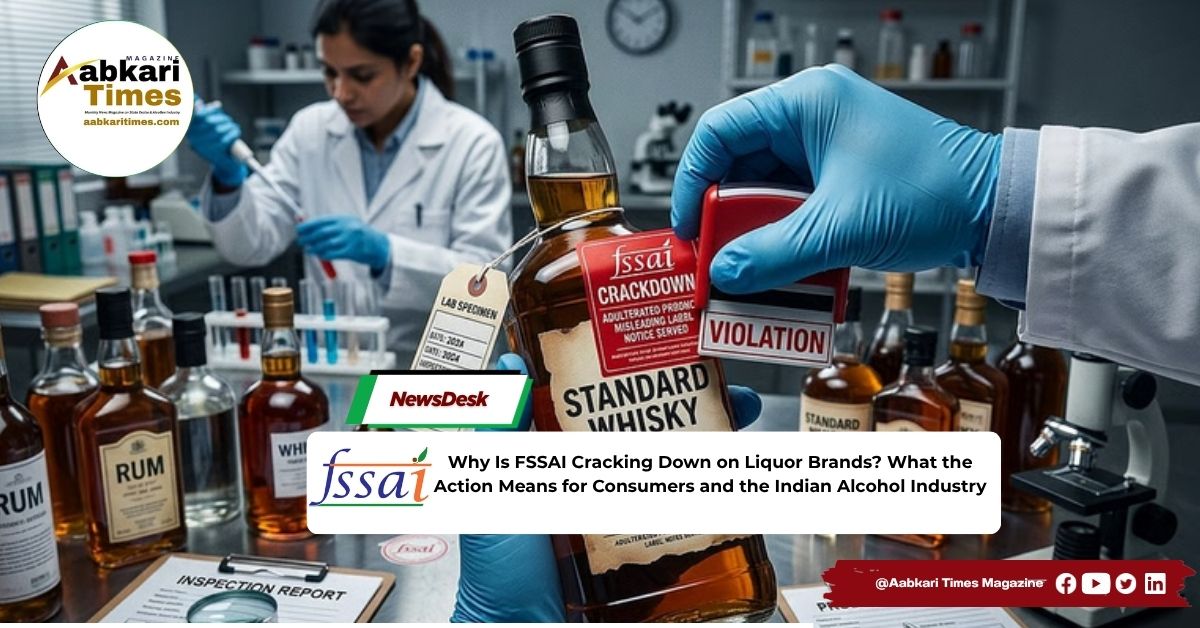
India’s food safety regulator, the Food Safety and Standards Authority of India (FSSAI), has initiated enforcement action against several liquor manufacturers over alleged violations involving artificial flavouring, misleading product labels and questionable age claims. The crackdown has drawn significant attention across the Indian alcoholic beverages industry because it raises concerns about whether some products sold as standard rum or whisky actually meet the regulatory definitions prescribed under Indian food safety laws.
According to FSSAI, the investigation began after laboratory testing of samples collected from multiple manufacturers detected the use of artificial or nature-identical flavouring substances that allegedly imitated the natural taste and aroma of rum or whisky. The regulator says that adding external rum flavour to rum or whisky flavour to whisky in order to recreate or enhance the beverage’s characteristic profile could mislead consumers into believing they are purchasing a traditionally produced spirit when the product has been artificially flavoured.
FSSAI has clarified that it is not imposing a blanket ban on flavouring substances in alcoholic beverages. Food safety regulations permit the use of flavouring agents when there is a genuine technological or manufacturing need. The issue under scrutiny is specifically the practice of using flavourings to artificially reproduce the defining sensory characteristics of rum or whisky while continuing to market the product simply as “Rum” or “Whisky.” In such cases, the regulator believes the product may not qualify as a standard alcoholic beverage under the Food Safety and Standards (Alcoholic Beverages) Regulations, 2018.
 Kerala Government Plans Strict Action Against Bars Serving Alcohol to People Below 23
 Odisha Bans New Liquor Shops for Three Years, CM Mohan Charan Majhi Announces Zero-Tolerance Policy on Drugs
The regulator has stated that products manufactured using these flavouring practices should be labelled in a manner that clearly discloses their true nature to consumers. Instead of being sold simply as rum or whisky, such products may need to carry descriptions such as “Rum-flavoured Spirit” or “Whisky-flavoured Spirit,” with the disclosure prominently displayed on the front of the package. FSSAI argues that transparent labelling is essential to prevent consumers from being misled about the composition and quality of the alcoholic beverage they are purchasing.
Another important aspect of the enforcement action involves a dispute over a “7 Years Old Blended” claim made by one rum brand. FSSAI’s investigation reportedly found that the product consisted largely of neutral, unaged spirit, while the matured rum component represented less than 5% of the blend. Under the 2018 Alcoholic Beverages Regulations, the age statement on a blended spirit must be determined by the youngest spirit in the blend, not by the oldest or a small matured component. If the youngest spirit is unaged, the regulator believes that presenting the product as “7 Years Old” could be misleading.
The Ministry of Health and Family Welfare has clarified that the current enforcement action is not directed at the entire Indian liquor industry. The action is limited to manufacturers that are alleged to have violated the applicable regulations. The ministry has also emphasised that many alcoholic beverage companies continue to produce standardised rum, whisky and other spirits in full compliance with prescribed food safety and labelling requirements.
For consumers, the FSSAI crackdown is significant because it focuses on transparency, accurate labelling and informed purchasing decisions. When a bottle is labelled as rum or whisky, consumers generally expect it to conform to recognised production standards and age declarations. If added flavourings have been used to create the beverage’s defining taste, or if the age statement does not reflect the youngest spirit in the blend, the label may not accurately represent the product inside the bottle.
FSSAI maintains that consumers have a right to know exactly what they are buying, whether it is a traditional matured spirit or a flavoured spirit beverage. Clearer labelling, the regulator says, will help protect consumer choice, reduce misleading marketing practices and ensure fair competition among manufacturers that comply with established food safety standards. The enforcement action also signals that Indian regulators are paying closer attention not only to the safety of alcoholic beverages but also to truthful product representation, flavour disclosure and age-statement integrity in the rapidly evolving Indian alcobev market.
About the Author