
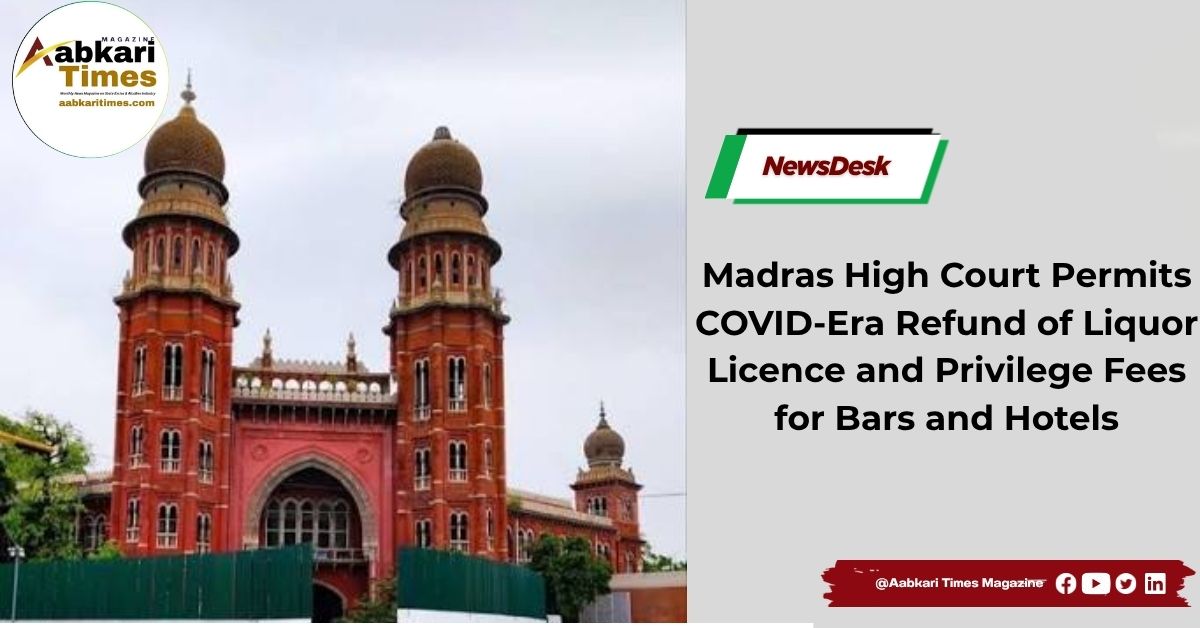
The Madras High Court has permitted F.L.III liquor licence holders operating bars and hotels in Tamil Nadu to seek a proportionate refund or adjustment of liquor licence and privilege fees for 171 days during which their businesses remained closed because of COVID-19 lockdown restrictions. The Court clarified that the relief is being granted on equitable grounds and not as a statutory entitlement under Rule 24-A of the Tamil Nadu Liquor (Licence and Permit) Rules, 1981.
A Division Bench comprising Justice G. Jayachandran and Justice N. Mala passed the order while hearing writ appeals filed by the State of Tamil Nadu and the Commissioner of Prohibition and Excise against a common order of a Single Judge. The Single Judge had earlier allowed petitions filed by F.L.III licence holders seeking refunds of licence and privilege fees for the period when their bars and hotels were forced to remain closed during the COVID-19 lockdown.
The central issue before the Bench was whether Rule 24-A permitted licence holders to claim a proportionate refund without surrendering their licences. The State argued that the rule requires surrender of the licence along with proof that no business was conducted under it. The State also contended that the proviso to Rule 24-A could not be treated as an independent provision creating a separate right to a refund for temporary closure.
 Kerala Government Plans Strict Action Against Bars Serving Alcohol to People Below 23
 Odisha Bans New Liquor Shops for Three Years, CM Mohan Charan Majhi Announces Zero-Tolerance Policy on Drugs
The licence holders argued that they were unable to conduct business because of government-imposed COVID-19 restrictions and that the closure was beyond their control. They contended that they should therefore be entitled to a proportionate refund for the period during which they could not operate their establishments.
The High Court agreed with the State that Rule 24-A does not create a standalone statutory right to a proportionate refund without surrender of the licence. The Bench held that the main provision contemplates surrender of the licence and proof of non-transaction of business as conditions for claiming a refund. According to the Court, the proviso primarily deals with the quantum of refund and cannot be read independently to remove the requirement of surrender.
The Court observed that interpreting the proviso as an independent source of refund would effectively alter the scheme of Rule 24-A. The provision was intended to address situations where a licensee wished to surrender the licence and claim a refund based on the period during which business had or had not been conducted. It was not designed to provide compensation for temporary closure followed by continuation of business under the same licence.
The Bench also considered the nature of liquor licence and privilege fees, observing that such payments are connected not only with the right to sell liquor but also with the State’s exclusive privilege over the trade and possession of intoxicating liquor. Referring to Supreme Court decisions including Har Shankar, Khoday Distilleries and Issac Peter, the Court reiterated that liquor licence fees represent consideration for acquiring the State’s privilege in the liquor trade.
Despite rejecting the interpretation of Rule 24-A adopted by the Single Judge, the High Court found the COVID-19 pandemic to be an exceptional force majeure circumstance. The Bench noted that the bars remained closed for 171 days due to government restrictions and that the licensees could not conduct business during that period because of circumstances beyond their control.
On equitable grounds, the Court therefore allowed the affected F.L.III licence holders to claim a partial or proportionate refund or adjustment of licence and privilege fees for 171 days, without surrendering their licences. However, the relief is subject to the licensees providing evidence that they did not transact business during the relevant period.
The High Court consequently allowed the writ appeals and set aside the Single Judge’s orders, while granting liberty to the affected licence holders to approach the Commissioner of Prohibition and Excise with their claims. The licensees must submit their claim petitions within two weeks, along with supporting documents establishing their eligibility for the refund.
The Commissioner of Prohibition and Excise has been directed to examine the claims and, if satisfied that they are genuine, pass appropriate orders on merits, preferably within 12 weeks. The Court also directed that there would be no order as to costs.
The judgment in State of Tamil Nadu & Anr. v. The Suguna Vilasa Sabha & Connected Matters provides limited relief to F.L.III bars and hotels affected by COVID-19 restrictions, while making it clear that the pandemic-related refund is based on equity rather than a general statutory right under Rule 24-A
About the Author