
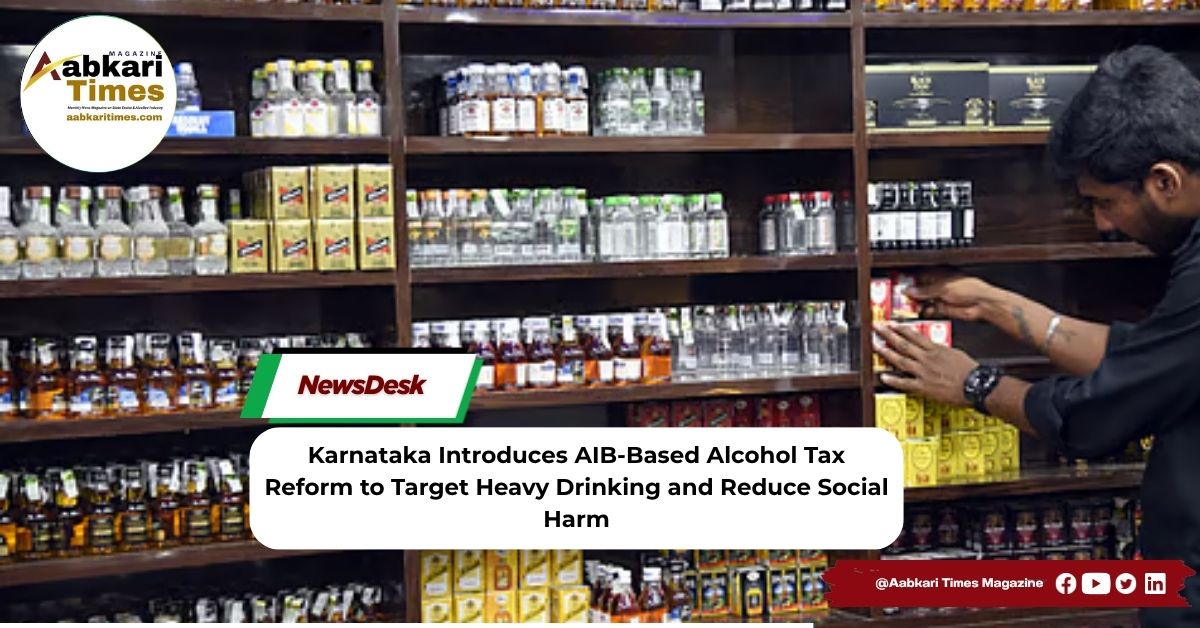
Bengaluru, August 2026: Karnataka has undertaken a major alcohol excise policy reform by becoming the first Indian state to adopt an Alcohol-in-Beverage (AIB)-based taxation system, a move aimed at addressing the social and health costs of heavy drinking while protecting the state’s excise revenue. The reform, implemented on May 11, 2026, marks a significant shift from India’s traditional liquor taxation model, where duties are generally imposed on the price of a bottle or the beverage category rather than the actual amount of pure alcohol it contains.
India’s per capita alcohol consumption has more than doubled, increasing from 2.4 litres of pure alcohol in 2005 to 4.9 litres in 2023, and is projected to reach 6.7 litres by 2030. Rising incomes, urbanisation, changing demographics and the growth of social drinking culture have contributed to this increase. At the same time, policymakers have become increasingly concerned about binge drinking, excessive alcohol consumption and the limited public understanding of alcohol strength and moderation.

According to the Resource Mobilization Committee (RMC) report submitted to the Karnataka government in April 2026 under the chairmanship of Dr. K.P. Krishnan, India’s existing excise framework has largely functioned as a revenue-maximisation mechanism rather than a tool for reducing alcohol-related harm. The committee recommended that responsibility for addressing public health consequences of alcohol consumption should be assigned to the Health and Family Welfare Department, rather than being left primarily with excise departments whose main mandate is revenue collection.
The RMC found that the earlier tax structure created a distortion in alcohol pricing, making high-strength spirits relatively cheaper per unit of alcohol than beer and wine. In Karnataka, Indian Made Foreign Liquor (IMFL) — which accounts for more than 90% of pure alcohol consumed in the state — was being taxed at approximately ₹1,123 per litre of pure alcohol, while low-alcohol beverages were effectively taxed at higher rates per unit of alcohol content.
 Monkey Shoulder Kicks Off 9th Ultimate Bartender Championship in India with New Delhi Round
 Tasmac to Invite Fresh Tenders for Bar Licences as Existing Permits Expire October 31
This imbalance reflects a broader national trend. India records the world’s highest per capita consumption of spirits at 13.5 litres of pure alcohol annually, compared with a global average of 4.3 litres. In contrast, countries such as Australia and Germany consume substantially more beer than spirits, indicating that lower-alcohol beverages play a larger role in overall alcohol consumption patterns in those markets.
Under Karnataka’s new AIB-based excise structure, every alcoholic beverage is taxed in direct proportion to the amount of pure alcohol it contains, regardless of whether it is spirits, beer or wine. For example, a 750 ml bottle of spirits at 42.8% alcohol contains about 321 ml of pure alcohol, a 750 ml bottle of wine at 12% contains about 90 ml, and a 650 ml bottle of beer at 5% contains about 32 ml. Excise duty is now calculated based on these alcohol quantities rather than the retail price or beverage category.
The Karnataka government has adopted a phased implementation plan to avoid a sudden disruption in excise revenue. The policy targets ₹1,542 per litre of pure alcohol in FY 2026–27, with a gradual increase to ₹2,000 per litre by FY 2028–29. This approach is intended to align taxation more closely with the actual alcohol content and associated social harm while maintaining fiscal stability.
The RMC estimates that alcohol consumption costs Karnataka around 2% of its Gross State Domestic Product (GSDP), or roughly ₹51,000 crore annually, through healthcare expenditure, road accidents, loss of productivity, domestic violence and other social consequences. International research cited in the report suggests that a 10% increase in alcohol prices can reduce consumption by about 5%, with the strongest impact observed among heavy drinkers and lower-income consumers.
The reform also creates incentives for the alcohol industry to reduce the alcohol strength of products. A similar outcome was observed in the United Kingdom in 2023, where a shift to alcohol-content-based taxation encouraged brewers to voluntarily lower alcohol levels in several products in order to reduce tax liabilities.
Recognising the risk that higher prices for cheap high-strength liquor could push some consumers toward illicit or adulterated alcohol, Karnataka has paired the tax reform with a QR-code-based track-and-trace system for every bottle sold in the state. The digital monitoring mechanism is intended to strengthen enforcement, reduce smuggling and improve the detection of illegal liquor.
With Karnataka accounting for roughly 17% of India’s IMFL sales, the implications of the reform extend beyond the state. The new policy demonstrates that an Indian state can redesign its alcohol taxation system around the actual source of alcohol-related harm — pure alcohol content — without imposing prohibition and without abandoning its fiscal interests. The Karnataka AIB-based excise model is now being closely watched as a potential template for future alcohol tax reforms in other Indian states seeking to balance revenue generation with public health objectives and responsible drinking policies.
About the Author