


Lucknow, August 7, 2026: The UP Excise Department has issued a comprehensive office order directing the mid-term revision of Maximum Retail Prices of UK-origin whisky and gin brands, following the reduction of customs duty from 150 per cent to 75 per cent under the India-UK Comprehensive Economic and Trade Agreement (CETA) which came into force from July 15, 2026. The order, signed by Excise Commissioner Dr. Adarsh Singh on August 7, 2026, lays out a detailed compliance framework governing how importers, wholesalers and retailers must manage the transition from old higher-MRP stock to new lower-MRP stock across Uttar Pradesh.
Since customs duty is a direct component of MRP under UP’s excise pricing formula prescribed in Paragraph 1.7.2 of the Excise Policy 2026-27, the duty reduction from 150 per cent to 75 per cent on whisky and gin of UK origin automatically triggers a mandatory downward revision of retail prices for all affected brands. The order applies only to consignments cleared at the preferential rate using an authenticated Unique Reference Number of Origin Declaration, as required under CBIC Circular No. 33/2026-Customs dated July 13, 2026.
Under the India-UK CETA, the conventional system of Certificates of Origin issued by designated authorities has been replaced with a trust-based self-certification system. UK exporters or producers self-declare the origin of their goods through an Origin Declaration, which must be transmitted simultaneously to CBIC’s nodal email address and the Indian importer’s ICEGATE-registered email. Once authenticated by CBIC, a Unique Reference Number is generated, which the importer must quote in their Bill of Entry to claim the preferential 75 per cent duty rate. Each Origin Declaration is valid for 12 months and covers a single shipment only it cannot be used for multiple importations. Importantly, authentication of the URN confirms only that the declaration came from a genuine registered UK exporter it does not automatically verify that the goods actually originate in the UK. The URN authenticates the sender, not the origin claim, which remains subject to separate post-clearance verification by customs. CBIC has indicated that a detailed trade advisory covering the full procedure for submission, authentication, URN generation and illustrative case scenarios will be issued separately on the ICEGATE portal a document that importers and BIO-1 licensees in Uttar Pradesh will need to monitor closely as they navigate the transition.
→ Paul John’s ₹8,200 Single Cask Whisky: What Makes The Doppelgänger Special?→ Johnnie Walker Black Label Whisky Price in Delhi, Mumbai, Gurgaon, Kolkata and Chennai

To manage the transition period during which old higher-duty stock and new lower-duty stock will co-exist in the supply chain, the order introduces a dual-eTIN system. Each affected brand will carry two separate registrations on the UP excise portal: the existing eTIN for old higher-MRP stock, and a new FTA-suffixed eTIN for lower-duty stock carrying the revised lower MRP. No brand registration or MRP approval fee will be charged for the new FTA-suffixed registration, since the revision is mandated by a Government of India customs duty change.
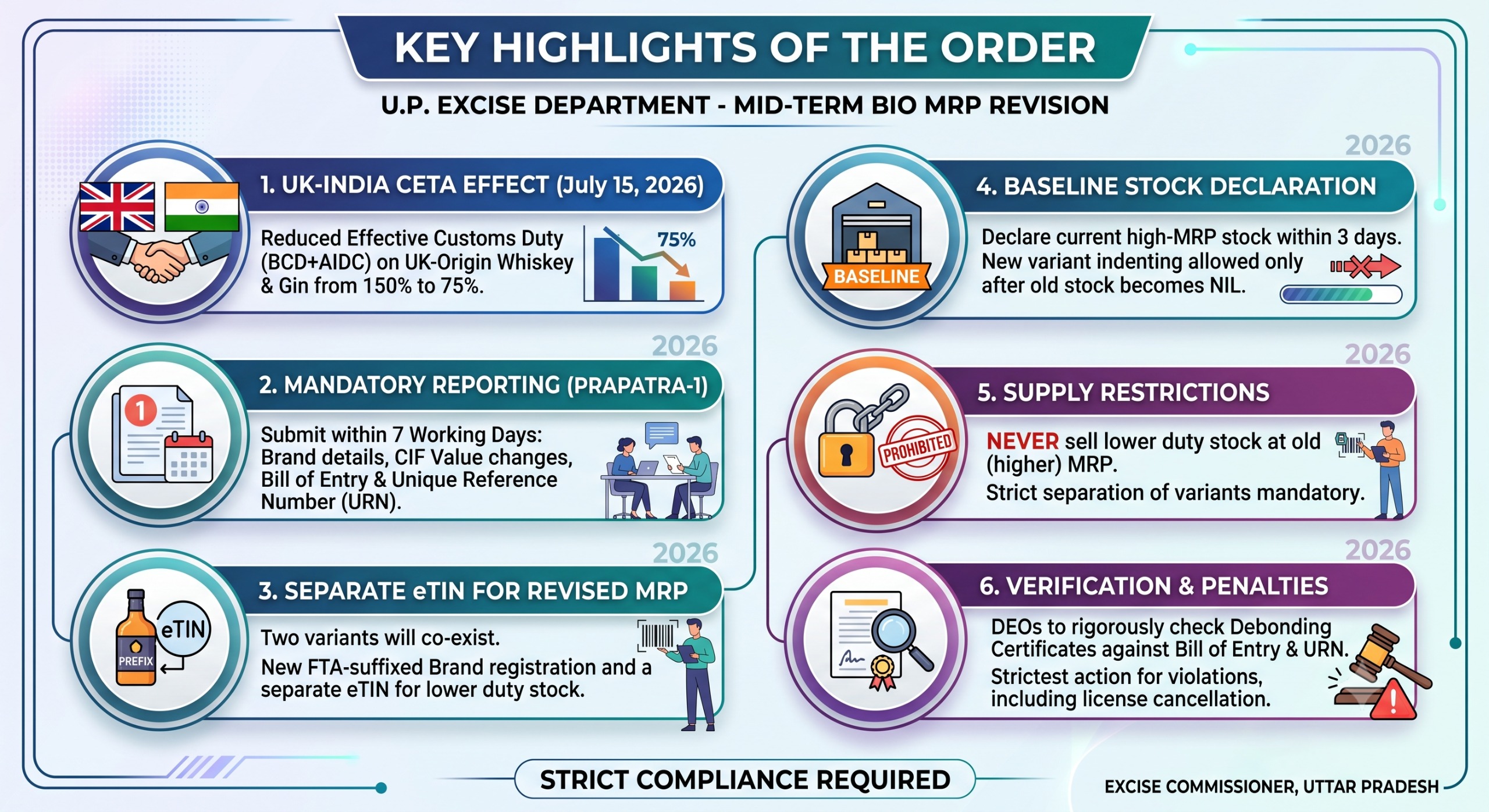 All BIO-1 licensees must submit brand-wise and pack-size-wise customs duty change details in Prapatra-1 format within 7 working days, including CIF value changes, latest Bill of Entry and the URN of the Origin Declaration. Every BIO-1 licensee must also submit a notarized affidavit in Prapatra-2 format on non-judicial stamp paper within 10 days, even those not intending to clear stock at the reduced duty rate this financial year, undertaking that lower-duty stock will never be sold at the old higher MRP.
All wholesale and retail licensees must declare current stock of higher-MRP variants as baseline stock on the departmental portal within 3 working days, subject to physical verification by District Excise Officers. The indenting system ensures a wholesaler or retailer can only begin ordering the new lower-MRP variant of a brand after old higher-MRP stock at their licensed premises is completely exhausted and shows NIL on the portal, preventing two MRP variants of the same brand from being simultaneously available at any single licensed outlet.
The order explicitly prohibits selling lower-duty stock at the old higher MRP at any level of the supply chain, classifying it as earning illegal profit against revenue interest. Violations will attract the strictest penal action under the UP Excise Act including licence cancellation, and separate recovery of loss caused to the state exchequer. District Excise Officers have been directed to conduct regular stock verification, surprise inspections, and mandatory examination of every Debonding Certificate before permitting entry of any stock into excise bond or godown.
The order represents one of the most detailed state-level compliance frameworks issued in response to the India-UK CETA, and is being watched closely by the industry as a model for how other states may approach the FTA duty transition.
For readers new to these terms
What is the India-UK CETA? It is a trade agreement between India and the United Kingdom under which import duties on several goods including Scotch whisky and British gin have been reduced. The duty on UK-origin whisky and gin was cut from 150 per cent to 75 per cent from July 15, 2026.
What is MRP revision? In Uttar Pradesh, the retail price of imported liquor is not set by the brand but is calculated by the government using a formula that includes the import duty. When duty goes down, the formula produces a lower price, so the government must revise the approved retail price of affected brands.
What is an eTIN? It is a unique registration code on the UP excise portal assigned to each brand and pack size of liquor. The order creates a second FTA-suffixed eTIN for new lower-duty stock so that old and new stock are tracked separately and cannot be mixed.
What does baseline stock declaration mean? Every importer, wholesaler and retailer must declare exactly how many bottles of old higher-priced stock they currently hold. This becomes the starting point for the government to track when old stock runs out and new lower-priced stock can begin flowing in.
What does this mean for consumers? As shops sell out existing Scotch whisky and gin stock at current prices, new bottles at lower prices will progressively appear on shelves across UP’s more than 27,000 retail outlets over the coming weeks.
About the Author