
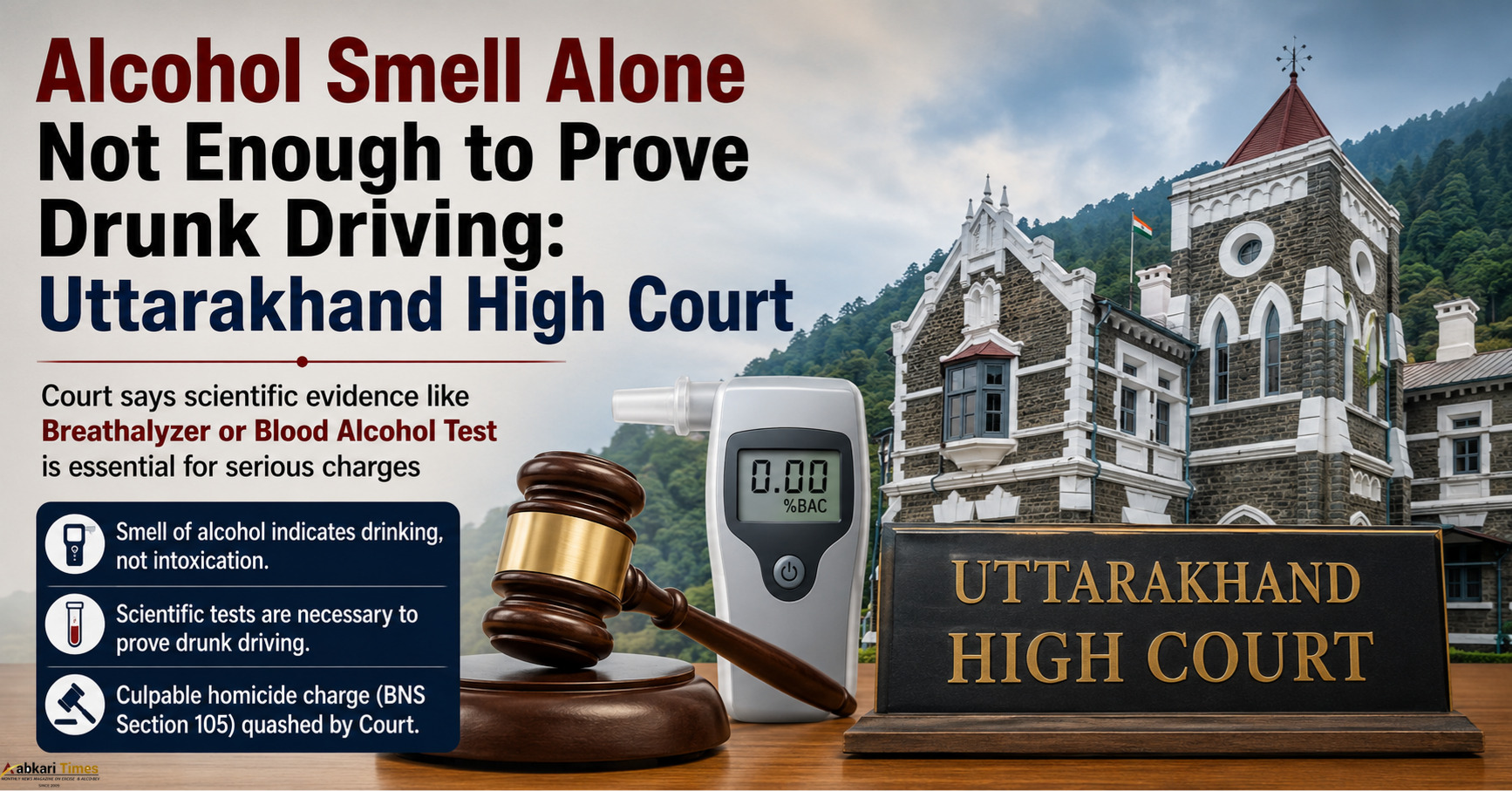
Uttarakhand High Court: Scientific Evidence Is Essential in Drunk Driving Cases
In a significant ruling, the Uttarakhand High Court has held that the mere smell of alcohol from a driver is not enough to prove drunk driving. The court observed that while the smell may indicate alcohol consumption, it does not establish that the driver was intoxicated or incapable of driving safely.
The judgment emphasizes that scientific evidence such as a breathalyzer test or blood alcohol analysis is necessary before a person can face serious criminal charges based on alleged drunken driving.
Court Removes Culpable Homicide Charge
Justice Alok Mehra delivered the decision while hearing a criminal revision petition filed by Amar Singh, a resident of Chamoli district.
→ Germany Expands Alcohol Bans at Major Train Stations to Curb Violence→ Delhi Excise Registers 725 FIRs and Arrests 730 in Five Months; Illegal Liquor Seizures More Than Double Ahead of Festive Season
The High Court quashed the charge under Section 105 of the Bharatiya Nyaya Sanhita (BNS), which relates to culpable homicide not amounting to murder. However, the court allowed the trial to continue under other provisions, including:
- Section 125(A): Causing hurt
- Section 125(B): Causing grievous hurt
- Section 281: Rash or negligent driving
The trial court has been directed to proceed with these charges without delay.
Accident Was Linked to a Tyre Burst
The case originated from a road accident in Chamoli involving a vehicle travelling from Badrinath. According to the investigation, the vehicle overturned after one of its tyres burst, resulting in the death of one passenger and injuries to several others.
Following the accident, the driver was accused of driving under the influence of alcohol and was booked under multiple sections of the BNS, including culpable homicide.
Technical Report Favoured the Driver
After examining the available evidence, the High Court found that the prosecution lacked reliable proof of intoxication.
The court relied on:
- The technical inspection report, which identified the tyre burst as the primary cause of the accident.
- Statements of eyewitnesses, who said the driver was operating the vehicle normally throughout the journey.
- The absence of visible signs of intoxication before the accident.
Although the medical examination mentioned the smell of alcohol, investigators had not conducted either a breathalyzer test or a blood alcohol test, leaving no scientific basis to establish intoxication.
High Court’s Key Observation
The court made it clear that smelling of alcohol cannot, by itself, prove that a person was driving under the influence. Without objective scientific evidence confirming intoxication, serious criminal charges such as culpable homicide cannot be sustained solely on the basis of suspicion.
The judgment reinforces the importance of evidence-based investigation in road accident cases and highlights the need for law enforcement agencies to conduct proper alcohol testing whenever drunk driving is suspected.
Why This Judgment Matters
The ruling sets an important legal precedent by distinguishing alcohol consumption from drunken driving. It underlines that criminal liability must be supported by scientifically verifiable evidence rather than assumptions based on the smell of alcohol alone.
For investigating agencies, the judgment also serves as a reminder that timely breathalyzer and blood alcohol tests are crucial for building a legally sustainable case in alleged drunk driving incidents.
About the Author