
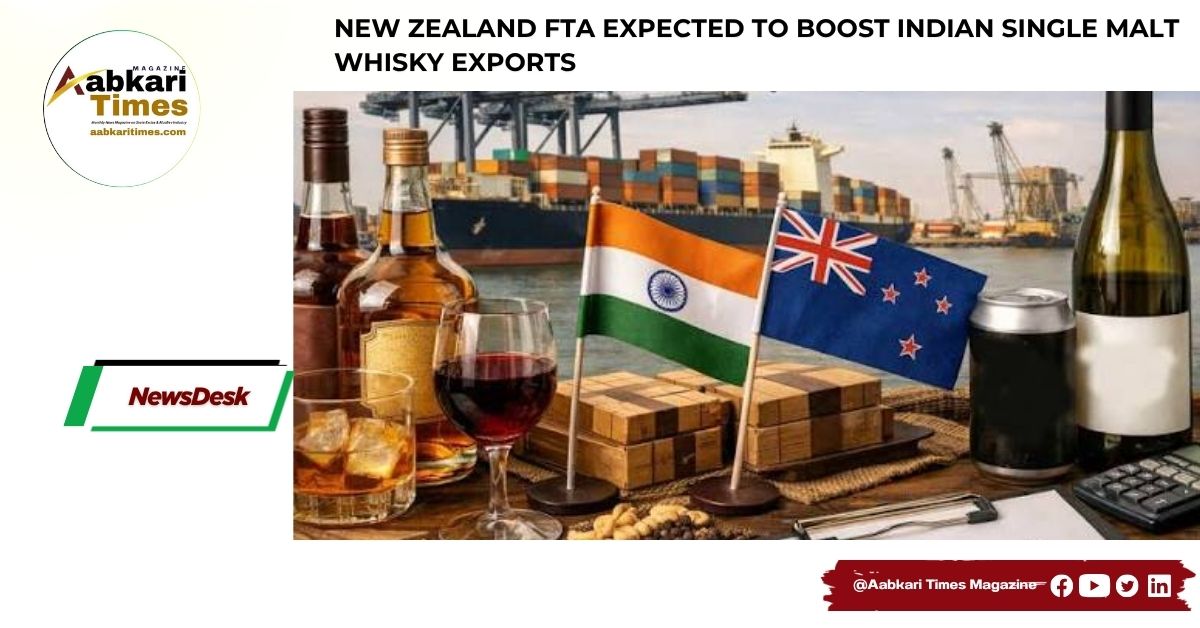
The proposed Free Trade Agreement (FTA) between India and New Zealand is expected to create significant opportunities for India’s alcoholic beverage industry, particularly for the fast-growing single malt whisky segment.
Industry experts believe that the agreement could help Indian premium spirits gain stronger access to the New Zealand market by reducing trade barriers and improving price competitiveness.
Major Opportunity for Indian Single Malts
According to the Confederation of Indian Alcoholic Beverage Companies (CIABC), the proposed trade pact is likely to provide tariff concessions for Indian alcoholic beverages. Lower import duties would make Indian products more competitively priced in New Zealand, helping domestic brands expand their international footprint.
 Scotch Whisky Association Appeals Against England’s New Single Malt Whisky Rules
 Top 10 Premium Whisky Brands in India Above ₹5,000 for the Festive Season
The Indian single malt whisky category has witnessed remarkable growth in recent years, with brands earning recognition at leading global competitions and attracting increasing interest from consumers worldwide. Industry leaders believe that improved market access through the FTA could further accelerate export growth.
Enhanced Competitiveness in Global Markets
Tariff reductions under the agreement would allow Indian whisky producers to compete more effectively with established international brands. Lower duties could reduce retail prices, improve margins for distributors, and encourage wider availability of Indian products in New Zealand’s premium spirits market.
The agreement is also expected to strengthen trade relations between the two countries and create new opportunities for Indian beverage manufacturers looking to diversify export destinations.
Positive Outlook for the Industry
The Indian alcoholic beverage industry views the proposed India–New Zealand FTA as an important step toward expanding global market access for domestic brands. With Indian single malts increasingly winning international awards and gaining consumer acceptance abroad, industry stakeholders believe the agreement could provide another strong platform for the growth of the “Made in India” spirits sector.
If implemented with meaningful tariff concessions, the FTA could help Indian single malt whiskies further enhance their presence in international markets and reinforce India’s emergence as a global producer of premium spirits.
ariff Concessions to Strengthen Global Competitiveness of Indian Spirits
According to the Confederation of Indian Alcoholic Beverage Companies (CIABC), the proposed India–New Zealand Free Trade Agreement (FTA) could significantly improve the competitiveness of Indian alcoholic beverages in international markets.
Once implemented, the agreement may allow Indian liquor products to enter the New Zealand market at either zero duty or reduced tariff rates. Such concessions would lower the cost of Indian products in the country and make them more attractive to consumers and distributors.
Greater Opportunities for Premium Indian Spirits
The tariff benefits are expected to provide a major boost to India’s premium spirits segment, particularly single malt whisky, rum, and other high-end alcoholic beverages. Reduced import duties would help Indian brands compete more effectively with established global players and strengthen their position in New Zealand’s premium beverage market.
Industry stakeholders believe that easier market access and improved price competitiveness could enable Indian producers to expand their distribution networks, increase exports, and build stronger brand recognition among international consumers.
Expanding the Global Footprint of Indian Brands
The proposed FTA is being viewed as an important opportunity for Indian spirits manufacturers to further establish themselves in overseas markets. With Indian single malts, premium rums, and craft spirits increasingly winning international awards and gaining global recognition, the agreement could help accelerate the industry’s export growth.
By creating a more favorable trading environment, the India–New Zealand FTA has the potential to enhance the global presence of Indian alcoholic beverages and reinforce the country’s reputation as a producer of world-class premium spirits.
New Zealand FTA Could Also Increase Premium Wine Imports into India
The proposed India–New Zealand Free Trade Agreement (FTA) is expected to benefit not only Indian spirit exporters but also New Zealand’s wine industry. Under the agreement, imports of premium wines from New Zealand into India could gradually increase as trade barriers are reduced and market access improves.
However, industry experts point out that India’s wine market remains relatively small compared to the country’s whisky, rum, and beer segments. As a result, any increase in wine imports is likely to be gradual rather than immediate.
Current Trade Volumes Remain Limited
At present, India’s exports of alcoholic beverages to New Zealand remain modest. The total annual export value of Indian spirits to the country is estimated at around US$1 million, with whisky, beer, and rum accounting for only a small share of the market.
Despite these limited volumes, industry observers believe the proposed FTA could serve as an important gateway for Indian beverage companies seeking to expand internationally. Improved market access and lower tariffs would provide an opportunity for Indian brands to establish themselves in a new and developed consumer market.
Opportunity for Indian Brands to Build Presence
The agreement is expected to create a favorable environment for Indian producers of single malt whisky, rum, beer, and other premium spirits to strengthen their overseas presence. By making Indian products more competitive in New Zealand, the FTA could help companies build brand recognition, expand distribution networks, and increase exports over the long term.
For Indian alcoholic beverage manufacturers, the proposed trade pact represents more than just tariff benefits—it offers a strategic opportunity to enter new markets, enhance global visibility, and further promote the growing reputation of “Made in India” spirits on the international stage.
Tequila Consumption in India Could Double by 2031
India’s alcoholic beverage market is undergoing a significant transformation. While whisky and wine continue to dominate, tequila and agave-based spirits are emerging as some of the fastest-growing categories in the country, driven by changing consumer preferences, premiumization, and an evolving cocktail culture.
Strong Growth in 2024-25
According to industry estimates, consumption of tequila and agave-based spirits in India grew by 31 percent in volume and 40 percent in value during 2024-25, making it one of the fastest-growing spirit categories globally.
Industry experts attribute this growth to the increasing popularity of cocktail culture in urban India and the growing preference for premium alcoholic beverages among younger consumers. Tequila is no longer viewed merely as a party drink; consumers are increasingly exploring premium variants and sipping them neat, much like premium whiskies and craft spirits.
Demand May Double by 2031
Market projections suggest that India’s agave spirits segment could grow at an average annual rate of around 14 percent over the next several years. If this growth trajectory continues, consumption could double by 2031, making tequila one of the most dynamic categories in the Indian spirits market.
While authentic tequila can only be produced in designated regions of Mexico, Indian producers are increasingly launching locally made agave-based spirits using agave cultivated in regions such as the Deccan plateau. These products are not marketed as tequila but are creating a distinct category of Indian agave spirits that is gaining consumer acceptance.
Indian Agave Brands Gain Ground
The rise of locally produced agave spirits is helping diversify India’s premium spirits landscape. Several domestic brands have entered the segment, offering consumers new flavor profiles and premium drinking experiences.
Industry observers note that these products are carving out their own identity rather than simply serving as substitutes for imported tequila. As awareness grows, Indian agave spirits are expected to become an increasingly important part of the country’s premium beverage portfolio.
Celebrity Backing to Accelerate Market Growth
The category is also attracting interest from high-profile entrepreneurs and celebrities. Reports indicate that prominent personalities such as Shah Rukh Khan, Aryan Khan, and Nikhil Kamath are associated with plans to launch premium agave-based spirit brands.
These ultra-premium offerings are expected to be positioned in the ₹20,000–₹30,000 per bottle range, further reinforcing the premiumization trend within the Indian alcohol market.
Whisky Still Dominates, but Preferences Are Evolving
Despite the rapid rise of tequila and agave spirits, whisky remains the dominant category in India, accounting for nearly 60 percent of the spirits market. However, younger consumers are increasingly seeking new experiences, international styles, and premium craft beverages.
This shift in consumer behavior is creating opportunities for emerging categories such as tequila, mezcal-inspired products, and Indian agave spirits. As experimentation and premium consumption continue to grow, tequila and agave-based drinks are expected to capture a significantly larger share of the Indian spirits market in the years ahead.
The trend highlights a broader evolution in India’s beverage industry, where consumers are moving beyond traditional choices and embracing a more diverse and premium drinking culture.
New Zealand Market Presents Challenges for Indian Spirits
While the proposed India–New Zealand Free Trade Agreement (FTA) offers promising opportunities for Indian alcoholic beverage exporters, industry experts caution that the New Zealand market also presents several challenges.
Wine and Beer Dominate Consumer Preferences
In New Zealand, wine and beer account for a significant share of alcoholic beverage consumption. As a result, Indian spirits brands will need to compete in a market where consumers are already strongly accustomed to locally produced wines and established international beer brands.
For Indian whisky, rum, and other premium spirits, building brand awareness and consumer acceptance will require sustained marketing efforts and strong distribution partnerships.
Complex Excise Duty Structure
Another challenge is New Zealand’s excise duty system, which applies different tax rates to various categories of alcoholic beverages. Wine, beer, and spirits are taxed under separate frameworks, creating a complex regulatory environment for exporters.
Even if tariff concessions are introduced under the FTA, Indian producers will still need to navigate local taxation and compliance requirements to remain competitive in the market.
Competition from Established Global Brands
Indian spirits will also face competition from well-established international brands that already have a strong presence in New Zealand. Premium whisky, gin, vodka, and rum categories are highly competitive, requiring new entrants to differentiate themselves through quality, pricing, innovation, and brand positioning.
Long-Term Opportunity Despite Challenges
Despite these hurdles, industry stakeholders believe the New Zealand market offers meaningful long-term potential for Indian beverage companies. Growing global recognition of Indian single malts, premium rums, and craft spirits, coupled with potential tariff benefits under the FTA, could help domestic brands gradually expand their presence in the country.
The consensus within the industry is that while New Zealand may not become a large export market immediately, it can serve as an important gateway for Indian spirits producers seeking to strengthen their footprint in developed international markets and enhance the global reputation of “Made in India” alcoholic beverages.
About the Author