
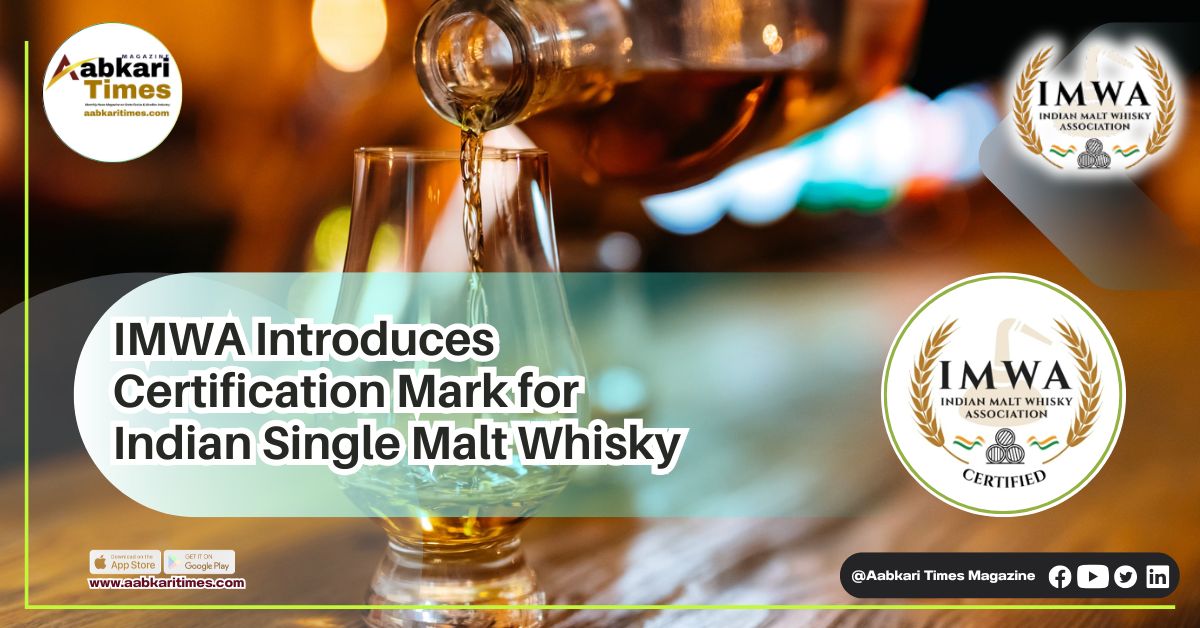
New Delhi, June 2026: The Indian Malt Whisky Association (IMWA) has launched a Certification Trademark in the form of a secure hologram for Indian single malt whiskies, introducing the category’s first formal, industry-led framework to define and verify authenticity. The move comes as Indian single malts gain rapid traction both domestically and globally, with the certification aimed at standardising what qualifies as a genuine Indian single malt in an increasingly fragmented market.
The hologram will be granted exclusively to manufacturers who comply with IMWA’s defined production standards. To qualify, a whisky must use 100 per cent malted barley with no molasses or neutral spirits, be produced at a single distillery in India, distilled in copper pot stills, and matured for a minimum of three years in oak casks not exceeding 700 litres. The entire process from mashing and distillation to maturation and bottling must take place within India, with no external flavouring agents permitted at any stage.
 Maj Gen (Dr) Rajesh Chopra, AVSM (Retd), Director General, IMWA, said: “As the Indian single malt category scales both domestically and globally, the need for a credible, industry-owned validation mechanism becomes critical. The certification mark is not just about compliance but about establishing a shared baseline of authenticity and process integrity. It aims to bring clarity in a fragmented market, reinforce consumer trust, and ensure that the category’s growth is built on verifiable standards rather than perception alone.”
 Scotch Whisky Association Appeals Against England’s New Single Malt Whisky Rules
 Top 10 Premium Whisky Brands in India Above ₹5,000 for the Festive Season
The certification is designed to address long-standing concerns around product authenticity in a category where definitions of “single malt” have often remained loosely applied across brands. By offering consumers a visible, verifiable identifier on qualifying bottles, IMWA aims to enable more informed purchasing decisions while raising quality benchmarks across the broader industry.
The move also carries export implications. By aligning India’s single malt production standards with globally recognised whisky benchmarks while still accounting for India’s distinct terroir and climatic conditions the certification is expected to improve export readiness and strengthen acceptance of Indian single malts in key international markets, where Scotch and other established categories have long dominated certification standards.
India’s single malt category has expanded significantly in recent years, with brands such as Amrut, Indri, Paul John and Rampur driving both domestic premiumisation and growing international recognition. A formal certification framework arrives at a point when the category’s credibility both with discerning domestic consumers and overseas buyers is becoming as important to its growth trajectory as production volumes.
With the certification framework now in place, the coming months will likely determine how many established and emerging single malt brands choose to adopt the IMWA hologram, and whether it becomes a recognised mark of trust for consumers the way certification marks have for other premium categories globally.
About the Author