
There is a tension at the heart of India’s beer market that Vivek Gupta, managing director and chief executive of United Breweries Ltd, is no longer content to leave unspoken. On one side sits a business facing real cost pressures — geopolitical turbulence, softening revenues, and a margin structure that has deteriorated sharply over the past year. On the other sits a consumer base whose continued participation in the category depends entirely on beer staying affordable.
For Gupta, allowing those two realities to collide — by simply transferring cost increases onto consumers — is not a viable strategy. It is, in his view, a threat to the entire category’s future.
“Affordability of beer is extremely important,” Gupta told reporters on Wednesday. “We do not want to create a problem for category growth simply by passing on pricing pressure to the consumer.”
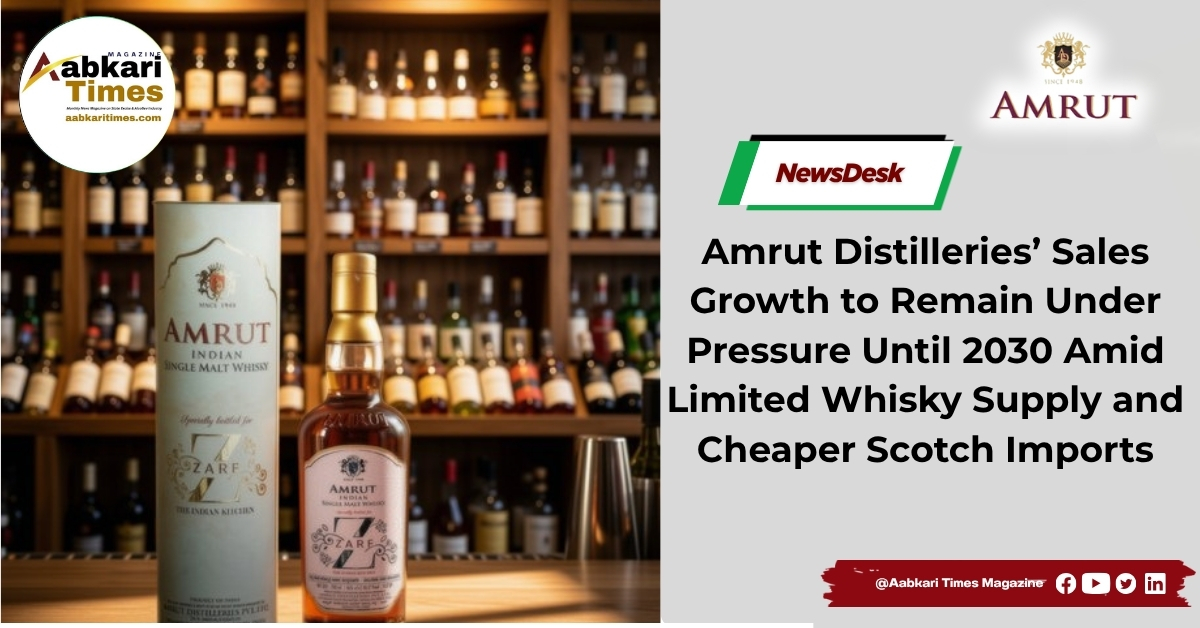
 Amrut Distilleries’ Sales Growth to Remain Under Pressure Until 2030 Amid Limited Whisky Supply and Cheaper Scotch Imports
 Japan Cuts Beer Taxes, Making Regular Beer Cheaper from October 2026
The Taxation Problem
The context for Gupta’s remarks is a tax structure that leaves brewers with limited room to absorb rising costs. According to the United Breweries chief, approximately seventy paise of every rupee a consumer spends on beer flows directly to state governments in the form of duties and levies. That leaves the industry with a narrow band within which to manage input cost volatility, particularly at a time when global commodity disruptions — including the ongoing conflict in the Middle East — continue to create supply-side uncertainty.
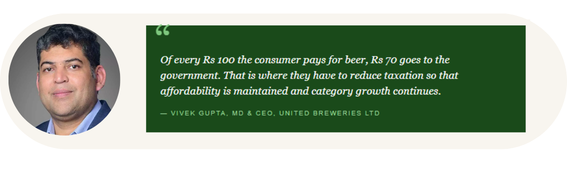 Gupta’s argument is structural rather than opportunistic. Unlike many consumer goods categories, beer manufacturers in India operate under state-controlled pricing regimes, limiting their ability to independently manage retail price points. “Unlike other industries,” Gupta noted, “we cannot simply go and pass on pricing to the consumer.” The implication is clear: without regulatory cooperation on taxation, the growth trajectory of the category itself is at risk.
Southern States in Focus
Gupta directed his appeal particularly toward Telangana, Andhra Pradesh, and Tamil Nadu — three southern states where United Breweries commands a strong consumer following and where volume exposure is significant. These markets have historically been among the most important for the Heineken-backed brewer, and any adverse pricing movement in these states would carry disproportionate consequences for the company’s overall performance.
|
Key context
Telangana, Andhra Pradesh, and Tamil Nadu are among UBL’s highest-volume markets. State governments in these regions control both excise duty rates and retail pricing approvals, giving them direct influence over beer’s affordability at the point of sale. |
The appeal to regulators is part of a broader pattern of engagement between India’s beer industry and state governments, where the industry has long argued that high taxation suppresses both volume and the formalisation of alcohol consumption — pushing drinkers toward lower-quality, unregulated alternatives.
Quarterly Financials: Profit Up, Margins Under Pressure
United Breweries reported its fourth-quarter results for fiscal year 2025–26 on Tuesday, presenting a mixed picture that underscores the urgency behind Gupta’s policy advocacy. While the company’s net profit rose 4.6% year-on-year to Rs 102 crore — compared with Rs 97.6 crore in the same period a year earlier — the broader operational picture was considerably more strained.
Revenue from operations declined over three percent to Rs 2,250 crore, against Rs 2,323 crore in the corresponding quarter of the prior fiscal year. More significantly, earnings before interest, taxes, depreciation, and amortisation fell by 25.5% to Rs 139 crore from Rs 187 crore, with the EBITDA margin compressing from 8% to 6.2% over the same period.
The company also flagged a projected cost impact of Rs 4–5 billion expected to materialise over the next two to three quarters, reinforcing the near-term pressure on margins.
About the Author