
There is a particular kind of market failure that looks, from the inside, like success — and the early story of tequila in India is exactly that. Bottles moved. Bar menus carried the name. Consumers ordered shots at parties. But the category was barely breathing. Without depth of understanding, without a culture of sipping, without any real engagement between brand and drinker, tequila in India was decorative rather than essential.
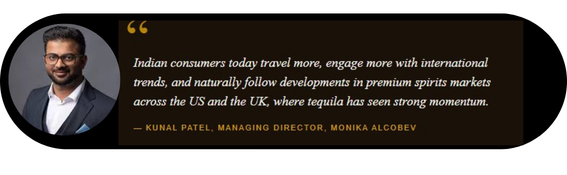
 That diagnosis belongs to Monika Alcobev, today the Indian distributor for Jose Cuervo, whose own entry into the market came years after the brand’s earlier distributors had already tried and stalled. “India did not reject tequila,” says Kunal Patel, managing director of Monika Alcobev. “It simply had not yet learned to understand it.”
Understanding, it turns out, was the entire project — and one that would take the better part of a decade to complete.
 Scotch Whisky Association Appeals Against England’s New Single Malt Whisky Rules
 Top 10 Premium Whisky Brands in India Above ₹5,000 for the Festive Season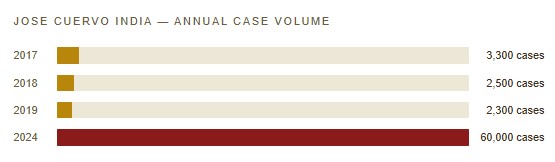
Three Attempts Before Traction
Jose Cuervo is no newcomer to global markets. As the world’s largest-selling tequila brand — with 8.9 million cases sold across 2024 — the Becle-owned label carries a commercial weight that few spirits can match. Yet India proved persistently resistant. The brand’s early partnerships, first through Focus Brands, then with Aspira from 2013 and Gulf Beverages distributing Yash Wines from 2015, each failed to build the momentum the category needed.
Sales volume declined steadily through the late 2010s, falling from roughly 3,300 cases in 2017 to 2,500 the following year, and to 2,300 in 2019. The figures told a story of a brand present but unanchored — stocked on shelves but disconnected from the drinking occasions that drive loyalty in premium spirits.
Monika Alcobev’s takeover of distribution in 2019 marked a deliberate reset. Rather than chasing short-term volume, the company redirected efforts toward building the category itself — a slower, more expensive strategy, but one calibrated for India’s particular market dynamics.
The Shift: From Shot Glass to Sipping Culture
The story of tequila’s transformation in India is inseparable from the wider evolution of the country’s drinking culture. A generation ago, international spirits arrived in India largely as status symbols — consumed less for flavour than for the signal they sent. Tequila, in particular, occupied a narrow niche as a celebratory shot: quick, loud, and culturally shallow.
What changed was a combination of global connectivity and rising consumer curiosity. Well-travelled drinkers returning from the United States, Europe, and Latin America brought back direct encounters with premium and ultra-premium agave spirits — 100% agave expressions that bore little resemblance to the mixto products common in Indian bars. These encounters seeded a new vocabulary: reposado, añejo, highland versus lowland, blue Weber agave.
The on-trade played a parallel role. India’s bartender community, increasingly plugged into international cocktail culture, began championing agave-forward drinks. Cocktails such as the Picante — a spicy tequila serve that has become a staple across the country’s leading bar programmes — gave consumers an accessible, flavourful entry point that the shot occasion never could.
Category Education as Competitive Advantage
Monika Alcobev’s approach to building the Jose Cuervo business centred on consistent, layered investment in trade relationships and consumer knowledge. Bartender advocacy programmes created a network of knowledgeable advocates at the point of service. Menu integration initiatives placed tequila-based cocktails in premium dining and nightlife venues where the target consumer was already spending.
On the consumer side, activations and experiential events converted abstract awareness into direct sensory engagement — the kind of encounter that turns a curious purchaser into a returning customer. Distribution expanded steadily across tier-one and tier-two cities, ensuring that the growing demand prompted by education could actually be fulfilled at retail.
The result, by 2024, was a volume figure of approximately 60,000 cases — representing an eighteenfold increase from the low point of 2019. For a category that had been contracting, the turnaround illustrates what targeted category investment can achieve when matched with favourable macro conditions.
A Market Primed for the Next Phase
The question now facing the industry is not whether tequila has arrived in India, but how fast it can grow from here. Patel is characteristically measured in his optimism: “Today, tequila is one of the most dynamic spirit categories in the country. Cocktails such as the Picante have become staples across leading bars, and consumers are increasingly seeking authenticity and higher-quality agave spirits.”
He frames the category’s future in the context of India’s premium spirits hierarchy: “This is not a short-term trend. Tequila is steadily moving toward becoming one of the core international spirits categories in India, alongside whisky, vodka, and rum.”
For trade professionals watching the segment, the growth trajectory suggests continued premiumisation — with aged variants in reposado and añejo expressions likely to capture a larger share as consumer confidence deepens. Celebrity-backed brands and the continuing influence of global bar culture will provide additional tailwinds. For the patient investors who stuck with the category through its difficult years, India’s tequila moment may only be beginning.
About the Author