

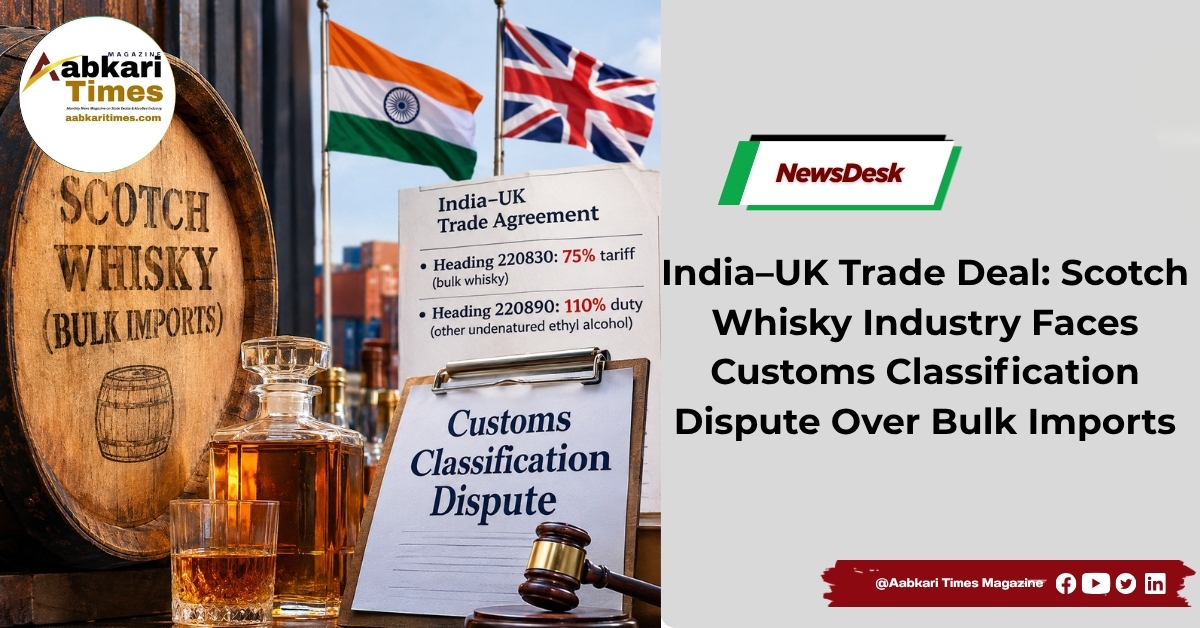
New Delhi: A customs classification dispute involving bulk Scotch whisky imports has emerged as a key challenge for the industry following the India–UK trade agreement, with questions being raised over the tariff concessions available to different categories of imported whisky. The issue centres on the classification of bulk whisky and concentrated spirits under different customs tariff headings, which attract significantly different import duty rates.
Under the trade agreement, bulk whisky classified under tariff heading 220830 has been offered a reduced tariff of 75%. However, products classified under heading 220890, covering other undenatured ethyl alcohol, continue to attract a reported duty of 110%. The distinction has become important for Scotch whisky exporters and Indian companies importing bulk spirits for blending and other manufacturing purposes.
The report highlights that the current dispute is rooted in earlier classification proceedings involving the industry. More than three decades ago, Bussa Overseas challenged the classification of imported bulk spirit. Subsequently, Pernod Ricard also contested the issue in 2008. The companies argued that the imported product, which contained approximately 60–61% alcoholic strength, should be classified under a different tariff heading to secure a lower duty. Customs authorities, however, sought to classify it as finished potable spirits under heading 220830. The dispute resulted in litigation over the applicable classification.
 Pernod Ricard Considers India IPO as Market Strengthens Its Global Importance
 India’s Scotch Whisky Tariff Dispute Continues as Bulk Shipments Face 150% Customs Duty
The matter has gained renewed significance following the India–UK trade agreement. While the agreement provides tariff concessions for specified Scotch whisky categories, heading 2106 remains outside the scope of the concessions. The industry is now seeking a change in classification from heading 2106 to 220890, highlighting the implications for bulk Scotch whisky imports.
The Scotch Whisky Association had also raised concerns over the issue in its submission to a UK parliamentary panel in August 2025. It stated that tariff code 220890 was used for the majority of bulk Scotch whisky exports for regulatory reasons but had not received the same level of liberalisation as specific Scotch whisky tariff codes.
The dispute highlights the importance of customs classification in determining the actual benefits of trade agreements. Indian authorities and industry representatives are reportedly engaged in discussions to find a solution that addresses classification concerns while ensuring the implementation of agreed tariff concessions.
About the Author