
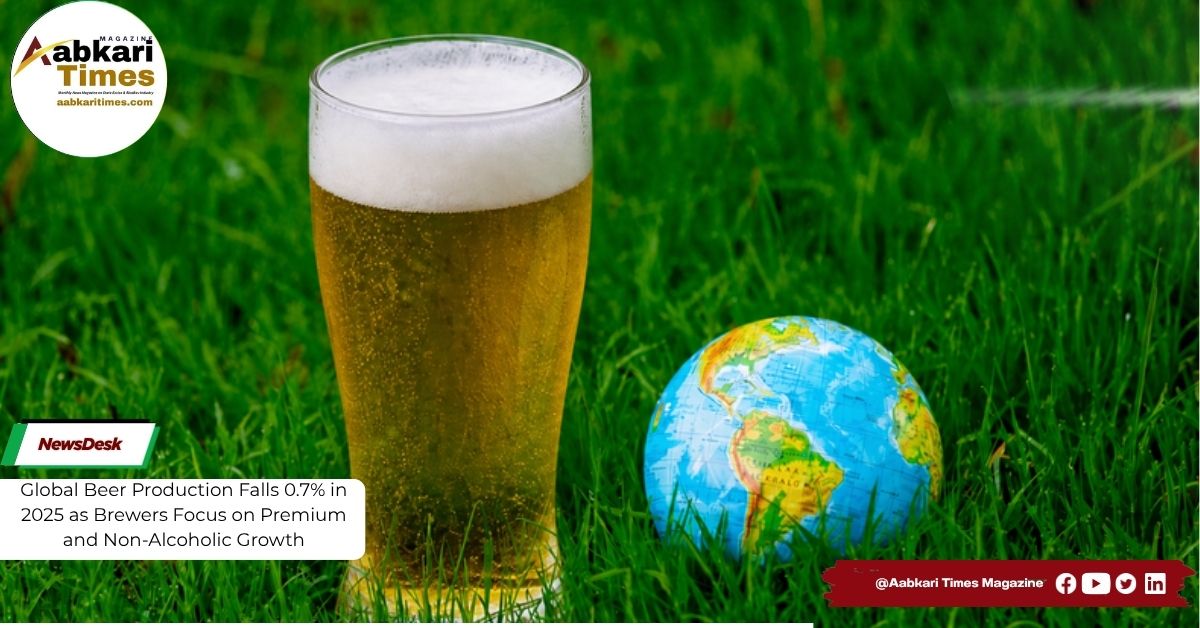
The global beer industry entered 2026 facing a clear divide between falling volumes and steady revenue growth. Worldwide beer production declined by 0.7% in 2025 as brewers increasingly relied on higher prices, premium brands, non-alcoholic beer, and diversified beverage portfolios to protect earnings. With consumer demand remaining weak in many mature markets, the industry is no longer depending on selling more beer each year.
According to BarthHaas, global beer production reached 1.875 billion hectoliters in 2024 and slipped to just under 1.9 billion hectoliters in 2025. The company’s outlook for 2026 suggests that the market will remain broadly flat, with no strong rebound in output expected. On the consumption side, Kirin estimated global beer consumption at 194.12 million kiloliters in 2024, a modest increase of 0.5% over the previous year. However, IWSR reported that beer volumes declined across several major markets in 2025, with improved product mix and continued growth in alcohol-free beer helping offset part of the weakness.
This trend is pushing brewers to focus on value rather than volume. Pricing discipline, premium labels, low- and no-alcohol products, and expansion into adjacent beverage categories such as soft drinks, mixers, and energy drinks have become central to industry strategy across North America, Europe, and Asia. As consumers become more selective about alcohol consumption and spending, large brewing groups are adapting their portfolios to capture growth in higher-margin segments.
 Amrut Distilleries’ Sales Growth to Remain Under Pressure Until 2030 Amid Limited Whisky Supply and Cheaper Scotch Imports
 Japan Cuts Beer Taxes, Making Regular Beer Cheaper from October 2026
The industry remains highly concentrated. BarthHaas’ 2025 ranking showed AB InBev producing 484.19 million hectoliters, followed by Heineken with 235.65 million hectoliters, China Resources Snow with 110.30 million hectoliters, and Carlsberg with 99 million hectoliters. These figures translate into estimated global production shares of roughly 25.5% for AB InBev, 12.4% for Heineken, 5.8% for China Resources Snow, and 5.2% for Carlsberg. Together, the top 40 brewing groups produced 1.586 billion hectoliters in 2025, accounting for about 84% of total world beer output. 
Scale has become increasingly important as brewers face a challenging cost environment. Energy prices have emerged as a renewed source of pressure in 2026 following geopolitical tensions in the Middle East. The World Bank projected a 24% rise in global energy prices this year, while the International Energy Agency reported that wholesale electricity prices in the European Union and Japan increased by more than 30% year-on-year during the second quarter of 2026.
Raw material conditions have been relatively more favorable. The Food and Agriculture Organization said global barley production remained stable at 142 million metric tons in 2024, and barley stocks are expected to stay relatively high heading into the 2026–27 season. Hops continue to face structural oversupply, with BarthHaas estimating a surplus of around 1,200 tons of alpha acids in 2025 despite reductions in cultivated acreage. While this has eased cost pressure for brewers, it has also weakened returns for barley and hop growers.
Regional performance highlights where growth opportunities remain strongest. Asia continued to be the world’s largest beer-consuming region in 2024 with 63.33 million kiloliters, representing 32.6% of global consumption, although volumes declined by 1.4%. Europe recorded growth of 1.4% to 49.23 million kiloliters, while Central and South America grew by 1.6%. Africa posted the strongest increase among major regions, with consumption rising 3.7% and production expanding by 6.7% in 2024. North America, by contrast, saw consumption decline by 0.5%.
China remained the world’s largest beer market by volume in 2024 at 40.534 million kiloliters, despite a decline of 3.7%. The United States followed with 22.34 million kiloliters, down 0.5%. Brazil consumed 15.304 million kiloliters, up 1.1%, while Mexico reached 10.787 million kiloliters, recording strong growth of 5.4%. Russia posted a 9% increase, whereas Germany’s consumption fell by 2.2%. India emerged as one of the fastest-growing major beer markets, with consumption rising by 14.6%, according to Kirin.
These figures reinforce a key investment theme for global brewers: mature markets are stagnating or shrinking, while emerging markets such as India and Africa continue to offer significant expansion potential. Both regions benefit from population growth, rising urbanization, and relatively low per capita beer consumption compared with traditional beer-drinking nations.
Per capita consumption data further illustrates the contrast. The Czech Republic remained the world leader in 2024 with 148.8 liters per person, followed by Lithuania at 110.6 liters and Austria at 104.6 liters. The United States stood at 65.4 liters per person. Although large markets such as China, the United States, and Brazil provide scale, high-consumption European countries remain important for premium positioning and brand value.
International trade also continues to play a major role in the beer industry. In 2024, Mexico was the largest exporter of malt beer by value at $6.50 billion, followed by the Netherlands at $1.80 billion, Belgium at $1.74 billion, and Germany at $1.34 billion. The United States was the world’s largest importer at $7.74 billion, far ahead of France and Italy. Mexico’s dominance reflects its close integration with U.S. beer demand, while European producers continue to lead premium and specialty beer exports.
To strengthen growth beyond traditional beer, major brewing companies are actively expanding their beverage portfolios. Carlsberg completed its $4.23 billion acquisition of Britvic in January 2025, significantly boosting its presence in soft drinks, mixers, and lower-alcohol beverages. Molson Coors expanded its total beverage strategy through its majority stake in ZOA Energy, while Diageo agreed to sell its 65% stake in East African Breweries to Asahi for $2.3 billion, a transaction that remains under regulatory and strategic scrutiny during 2026 because it would substantially increase Asahi’s exposure to African brewing markets.
Overall, the global beer industry is undergoing a structural shift. Volume growth is no longer guaranteed, and brewers are increasingly competing through premiumization, alcohol-free innovation, pricing power, and diversified beverage portfolios. As energy costs remain volatile and consumer behavior continues to evolve, emerging markets such as India and Africa are expected to play a much larger role in shaping the next phase of global beer industry growth.
About the Author