
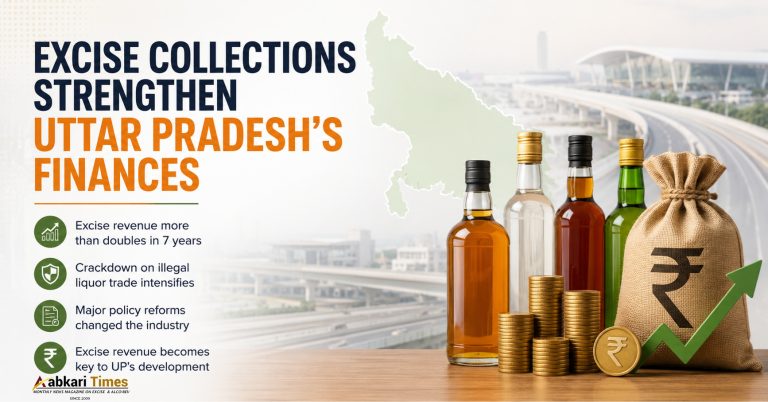
Excise Collections Strengthen Uttar Pradesh’s Finances
Uttar Pradesh’s excise sector has emerged as one of the state government’s strongest revenue engines, helping finance large-scale infrastructure projects, welfare schemes and industrial development. Rising liquor sales, stricter enforcement and major policy reforms have significantly increased the state’s excise collections over the past several years.
According to recent figures released by the Uttar Pradesh excise department, the state earned Rs 10,635.69 crore in excise revenue during April and May of the current financial year. The department collected nearly Rs 5,248 crore in April and Rs 5,387 crore in May, reflecting an increase of around 8.9 percent compared to the same period last year.
Excise Revenue More Than Doubles in Seven Years
The latest figures continue a long-term growth trend in Uttar Pradesh’s liquor revenue collections. Excise earnings have more than doubled over the past seven years, rising from Rs 23,927 crore in 2018-19 to over Rs 52,500 crore in 2024-25.
 Odisha Collects ₹24,455 Crore in Excise Duty Over Five Years, CAG Report Reveals
 Nasha Mukt Yuva for Viksit Bharat UP Prohibition Department Holds Youth Awareness Seminar at AKTU Lucknow
The steady rise has made the excise department one of the biggest contributors to the state exchequer. Officials credit the growth to improved monitoring systems, tighter compliance measures and reforms aimed at reducing revenue leakage across the liquor trade.
The government has also focused heavily on increasing legal liquor sales while cracking down on illegal alcohol operations across the state.
Crackdown on Illegal Liquor Trade Intensifies
Alongside higher revenue collections, Uttar Pradesh authorities have strengthened enforcement against illicit liquor manufacturing and smuggling networks. Officials say thousands of raids and inspections are being conducted regularly to prevent illegal trade.
In May alone, nearly 9,900 cases related to illegal liquor activities were registered across the state. Authorities seized more than 229,000 litres of illicit liquor, arrested over 1,500 people and confiscated vehicles allegedly used for smuggling operations.
The state government believes that stronger enforcement not only improves public safety but also helps protect legitimate revenue collections from illegal competition.
Major Policy Reforms Changed the Liquor Industry
A major turning point came in 2018 when the Uttar Pradesh government introduced sweeping reforms in the liquor licensing system. The administration abolished several special licensing arrangements that critics claimed favoured a limited group of influential operators.
The state introduced a more transparent and uniform licensing structure while moving many approval and monitoring processes online. Restrictions were also imposed on the number of licences an individual or business group could hold.
Officials say the reforms were designed to improve transparency, encourage wider participation in the liquor business and reduce corruption and revenue leakage.
Over time, the state has also started positioning the alcohol sector as an investment opportunity. Last year, the excise department organised its first dedicated investor summit for the liquor industry, attracting investment proposals worth more than Rs 4,300 crore in manufacturing, bottling, warehousing and related sectors.
Excise Revenue Becomes Key to UP’s Development Plans
The rapid growth in excise collections comes at a crucial time for Uttar Pradesh, which is investing heavily in expressways, airports, urban infrastructure, industrial corridors and welfare programmes.
While GST collections and stamp duty remain important revenue sources, excise income has become increasingly reliable because of its stable and predictable nature. The government’s strategy now focuses on balancing revenue growth with tighter regulation and improved compliance.
However, the liquor sector remains politically sensitive. Public debates around prohibition, social impact and public health continue to influence policy discussions in many parts of the state.
Despite these challenges, rising excise collections, stronger enforcement and growing investor interest indicate that Uttar Pradesh’s liquor trade reforms are playing an increasingly important role in strengthening the state economy and supporting its broader development agenda.
About the Author