
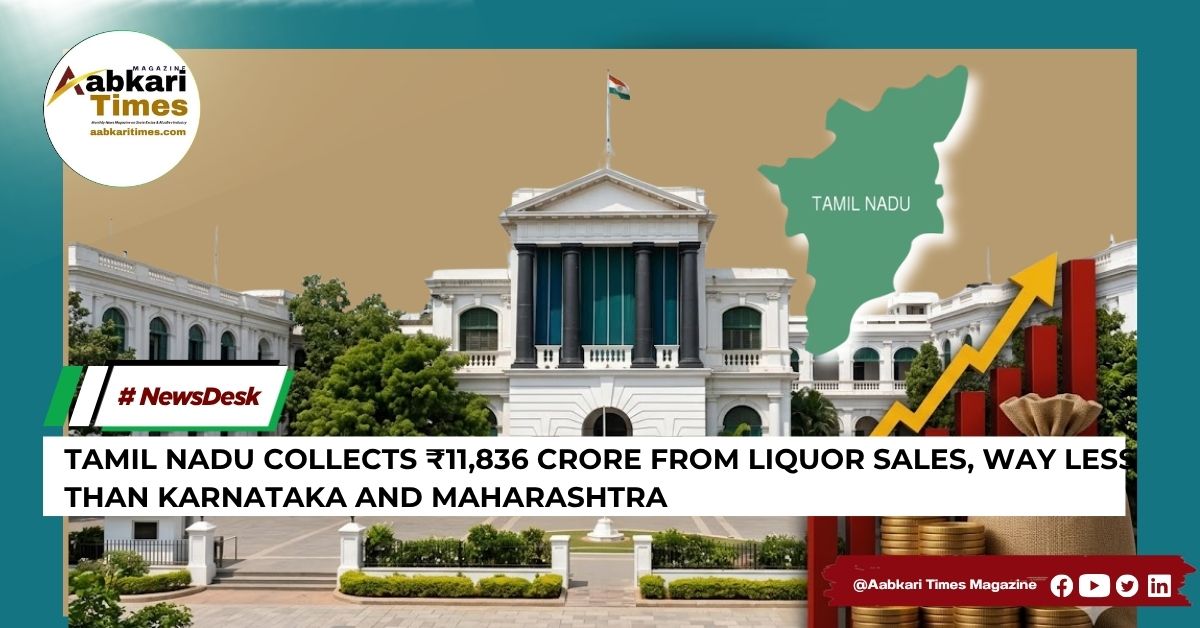
Chennai, June 2026: Tamil Nadu collected ₹11,836 crore in excise duty in 2025-26 the lowest among its peer states and sharply behind Karnataka’s ₹41,000 crore and Maharashtra’s ₹34,170 crore, according to a white paper on state finances released by the TVK-led Tamil Nadu government. Excise revenue in Tamil Nadu grew at a compound annual growth rate of 9.49 per cent over the review period, slower than Karnataka’s 11.66 per cent and well behind Maharashtra’s 18.69 per cent.
Finance Minister N Marie Wilson presented the white paper at the state Secretariat, examining Tamil Nadu’s revenue performance from 2021-22 to 2025-26. With both the smallest excise base and the slowest pace of growth among the peer states, the document identifies this revenue differential as one of the largest identifiable gaps in Tamil Nadu’s overall State Own Tax Revenue.
 Despite trailing its peers in absolute terms, excise duties and VAT on liquor combined still account for 26 per cent of Tamil Nadu’s State Own Tax Revenue making it one of the most significant individual revenue heads for the state. Within the state’s commercial tax structure specifically, VAT on liquor contributes roughly 28 per cent, second only to GST. This means even a modest improvement in excise efficiency carries an outsized impact on Tamil Nadu’s overall tax collections compared to most other revenue heads.
 Odisha Collects ₹24,455 Crore in Excise Duty Over Five Years, CAG Report Reveals
 Nasha Mukt Yuva for Viksit Bharat UP Prohibition Department Holds Youth Awareness Seminar at AKTU Lucknow
The white paper attributes the excise shortfall to administrative and policy gaps rather than weak consumption demand, citing leakages and systemic corruption within revenue-collecting departments as contributing factors. Wilson said the new state government’s priority going forward would be plugging these leakages and improving collection efficiency with state excise specifically named alongside GST, petroleum VAT, stamp duty and motor vehicle tax as departments requiring administrative reform.
The comparison with Karnataka and Maharashtra is particularly telling for the alco-bev industry. Both states have built significantly larger organised retail liquor networks and have pushed premiumisation more aggressively over the past five years factors that have helped widen their excise collections relative to Tamil Nadu, independent of population or consumption differences.
For industry stakeholders, the white paper signals that Tamil Nadu’s excise department could be headed for administrative changes in the months ahead, as the new government looks to close the revenue gap with its southern and western peer states. Whether this translates into retail expansion, pricing reform, or stricter enforcement against leakages will become clearer once the state’s 2026-27 budget and accompanying excise policy measures are unveiled.
About the Author