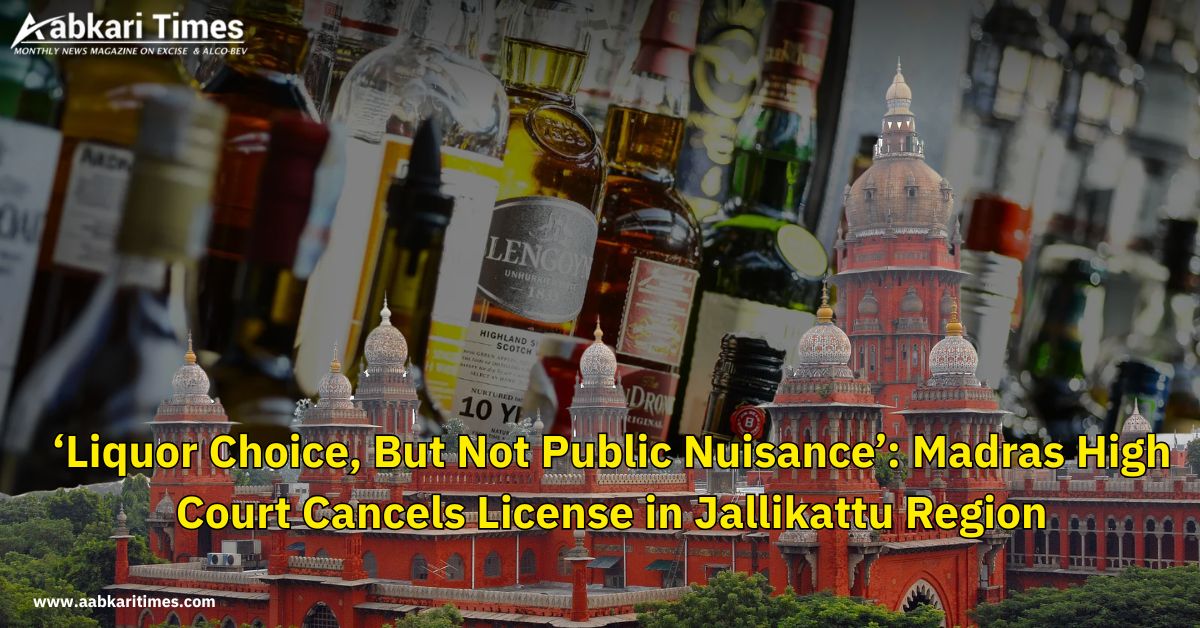
In a significant ruling, the Madras High Court has cancelled a liquor license granted to a private recreation club in Thandalai village, located in Madurai district—an area known for its strong cultural ties to the famous Jallikattu tradition.
The court made it clear that while drinking alcohol is a personal choice, it cannot come at the cost of public peace and safety. If a liquor outlet creates disturbance or poses a threat to local residents, authorities must step in.
The judgment was delivered by a division bench comprising Justices N. Sathish Kumar and M. Jothiraman, who were hearing a Public Interest Litigation (PIL) filed by villagers opposing the liquor outlet.
Community Will Takes Priority
The court placed strong emphasis on the role of local self-governance bodies. It noted that the village panchayats had passed resolutions—twice—clearly opposing the establishment of liquor shops or bars in the area.
According to the bench, such resolutions reflect the collective will and welfare priorities of the community, especially in matters related to public health, morality, and overall well-being. Ignoring these objections, the court observed, undermines the very purpose of grassroots governance.

Background of the Case
The case originated from a PIL filed by local residents challenging a license issued in October 2025 to a private entity, Pons Recreation Club.
The petitioners argued that the Alanganallur region, which includes 36 villages and is globally recognised for its cultural heritage, has historically resisted the presence of liquor outlets.
They also alleged that the club had bypassed licensing norms by acquiring an existing society and renaming it in early 2025 to meet eligibility conditions—specifically the requirement of operating for a minimum period under Tamil Nadu’s liquor rules.
Legal and Policy Concerns
The court also examined provisions of the Tamil Nadu Prohibition Act, 1937, which regulates the manufacture, sale, and consumption of alcohol in the state.
It highlighted that public intoxication is punishable under the law, reinforcing the need to regulate liquor sales carefully.
Further, the judges pointed out that the recreation club’s bylaws did not explicitly permit the sale of alcohol. This raised serious legal concerns, as such permissions are required under the Tamil Nadu Societies Registration Act, 1975. Allowing liquor sales without proper provisions would amount to a violation of the society’s own rules.
Panchayats Have Constitutional Authority
A key aspect of the ruling was the recognition of the powers of village institutions under the Constitution. The court noted that gram sabhas and panchayats are empowered under the 73rd Constitutional Amendment Act, 1992 to function as institutions of self-governance.
These bodies are meant to represent the people directly and make decisions on issues affecting local communities. Therefore, their resolutions cannot be ignored, especially when they clearly oppose activities that may harm public welfare.
The Court’s Message
The ruling sends a clear message: while individuals are free to make personal choices like consuming alcohol, businesses cannot operate in ways that disrupt community life or go against the collective will of residents.
By cancelling the license, the court has reinforced the importance of respecting local governance, cultural sensitivities, and the broader public interest.