Shimla, February 18, 2026 – The Himachal Pradesh government has rolled out its Excise Policy for the financial year 2026-27, approved by the Chief Minister on February 12, 2026, and notified via government letter dated February 16, 2026. The policy emphasizes transparency through e-auctions for retail liquor vends, sets minimum guaranteed quotas (MGQ) for country liquor and IMFL, and revises duties, fees, and penalties to enhance state revenue while regulating the liquor trade.
This comprehensive framework, governed by the Himachal Pradesh Excise Act, 2011, and related rules, aims to maximize revenue, ensure responsible consumption, and support local manufacturing. Here’s a detailed breakdown of the key highlights.
Transparent E-Auction for Retail Liquor Licenses
The policy introduces an e-auction system for allotting retail licenses in forms L-2 (urban areas), L-14 and L-14A (rural areas), and L-20B (country fermented liquor like Jhol). Units are formed based on sub-division or tehsil boundaries, with a maximum value of Rs. 15 crore per unit to ensure viability and geographical balance. Buffer zones of 100 meters in urban areas and 200 meters in rural areas are mandated between adjoining units.
Applicants, including individuals, companies, cooperatives, partnerships, or Hindu undivided families, must meet eligibility criteria such as Indian citizenship, age above 21, no criminal background, and solvency equivalent to at least 25% of the unit’s annual license fee. Non-refundable application fees range from Rs. 25,000 for fermented liquor to Rs. 2 lakh for high-value units, with an earnest money deposit (EMD) of 2% of the reserve price.
The reserve price is calculated based on MGQ for country liquor and IMFL, with license fees adjusted proportionally to bids. Successful bidders must deposit fees quarterly and face penalties for shortfalls below 80% of MGQ.
Minimum Guaranteed Quotas and License Fees
The policy fixes district-wise MGQ for country liquor (totaling 29,926,319 proof liters) and IMFL (19,965,786 proof liters), with open quotas for BII and foreign liquor. For beer, a fixed quota of 14,905,737 bulk liters is set, with penalties of Rs. 25 per bulk liter for lifting below 80%.
License fees are slab-based:
- Country Liquor: Rs. 295 per proof liter (standard), Rs. 315 for high strength.
- IMFL: Rs. 435–490 per proof liter based on ex-distillery price (EDP) slabs.
- Beer: Rs. 65–75 per bulk liter.
- BIO (Foreign Liquor): Rs. 350 per proof liter.
Assessed fees for bars, hotels, and clubs (L-3, L-4, L-5, etc.) range from Rs. 550–1,370 per bulk liter, with special rates for CSD supplies.
Quota conversions between country liquor and IMFL are allowed up to 30% quarterly, with a Rs. 55 per proof liter fee. Additional quotas beyond MGQ incur full license fees.
Revised Excise Duties and Other Levies
Excise duties have been updated:
- Country Liquor: Rs. 38–53 per proof liter.
- IMFL: Rs. 75–185 per proof liter.
- Beer: Rs. 37–51 per bulk liter.
- RTD Beverages: Rs. 21–37 per bulk liter.
- Wines/Ciders: Rs. 9–50 per bottle/bulk liter.
Export fees range from Rs. 0.25–4.50 per bulk/proof liter, while import fees apply to bottled IMFS (Rs. 36 per proof liter), beer (Rs. 6–8 per unit), and others.
Additional levies include:
- Rs. 5.50 per 750 ml bottle on country liquor and IMFL for social welfare, ambulance services, and cow protection (Gaudhan Vikas Nidhi).
- Milk Cess: Rs. 10 per bottle across categories.
- Prakritik Kheti Cess (PK Cess): Rs. 2–5 per bottle.
- Excise and Taxation Development Fund: Rs. 1.50–5.50 per bottle/can.
- WDA Cess (for widowed/destitute women and disabled parents): Rs. 1.50 per bulk liter on exports.
These measures are expected to generate substantial revenue while promoting social causes.
Regulations for Country and Foreign Liquor
Country liquor must be made from ENA, with strengths of 50° or 40° under proof, bottled in glass or tetra packs, and labeled with health warnings. Supplies come from state manufacturers via L-13 wholesalers.
For foreign liquor, partial import restrictions apply: Brands with EDP below Rs. 3,000 per case must be sourced locally. BIO brands follow a dedicated policy (see below), with holograms and “For Sale in Himachal Pradesh Only” stickers mandatory.
Microbreweries (L-10C) and micro distilleries in tribal areas (D2-T) are promoted, with fixed fees and conditions for local production.
New Licenses and Innovations
The policy continues licenses introduced since 2019-20:
- L-50C: For bakeries possessing rum/wine for confectionery.
- S-1C: Wholesale wine/cider trade.
- L-50B: Serving liquor in banquet halls/parties.
- L-6A: Serving in hotel lawns/terraces.
- D-2E: Ethanol manufacturing.
- L-9/L-9A/L-9AA: For armed forces/CAPF.
- S-1WT/S-1WF: Wine tasting festivals.
- L-3T/L-4T/L-5T: Tented accommodations.
- L-1CC: Storage/supply of IMFS.
- LHS-1: Home stays/guest houses.
- LFC-1: Food courts/restaurants serving wine/beer.
- D-2M: Maturation of spirits.
- DT-1: Distillery tours.
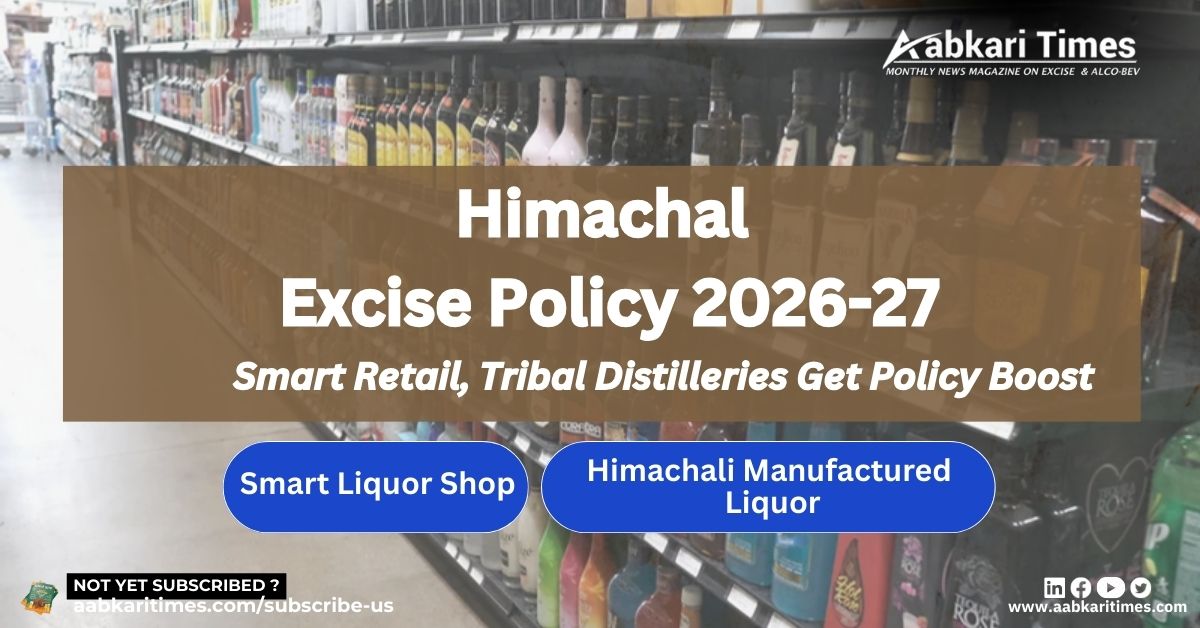
- L-10CC: Smart liquor shops selling premium brands alongside groceries.
By introducing specialized categories for wineries, micro-distilleries in tribal areas, smart retail formats, and experiential services, the state reinforces its commitment to revenue growth while ensuring transparency, compliance, and responsible trade management.
A defining feature of the 2026–27 policy is its emphasis on promoting Himachal’s regional identity through the branding of “Himachali Manufactured Liquor” or “Himachal Royal Liquor,” alongside tourism-oriented initiatives such as distillery tours and spirit maturation facilities beyond factory premises. These forward-looking measures not only strengthen local value chains—from horticulture to hospitalit y—but also position Himachal Pradesh as a distinctive alcobev destination, blending heritage, innovation, and economic opportunity within a structured regulatory framework.
Strict Penalties for Violations
Penalties are stringent:
- Unauthorized liquor in banquets: Rs. 50,000–1,00,000, leading to cancellation.
- Bars serving outside premises: Rs. 20,000–50,000, cancellation on fourth offense.
- Overcharging/Minimum price violations: Vend sealing for 1–2 days.
- Excess ENA/stock discrepancies: Rs. 1–3 lakh plus confiscation.
- Plastic bottles/pouches: Rs. 50,000.
These ensure compliance and deter illegal activities.
BIO Brands Policy: Streamlined Import and Distribution
BIO (imported) brands must be supplied via public custom bonded warehouses. L-1BB wholesalers procure from L-1BIO space holders, who require brand owner authorizations and Rs. 10 lakh security. Holograms, stickers, and health warnings are mandatory. In supply shortages, direct imports are allowed with permissions.
Impact on Revenue and Industry
The policy is projected to increase excise revenue through higher quotas, fees, and cesses, supporting welfare initiatives like cow protection and women’s empowerment. It promotes local manufacturing, tourism-linked licenses (e.g., distillery tours), and responsible consumption via warnings and restrictions.
Stakeholders, including distillers and retailers, must comply with e-auction timelines and online processes via https://www.hptax.gov.in. For queries, contact the Department of State Taxes and Excise.
Stay updated on Himachal Pradesh excise policy changes, liquor license auctions, and revenue impacts.

The Aabkari(Abkari) Times magazine occupies a unique niche in the Indian media landscape. As the only Hindi monthly magazine dedicated to alcohol, liquor, excise, and allied industries, it caters to a specific audience with a specialized knowledge base.